

Stay Connected with Grow Your WHY
Recent Posts


Archives
4 Levels of the Progression to Intrinsic Motivation


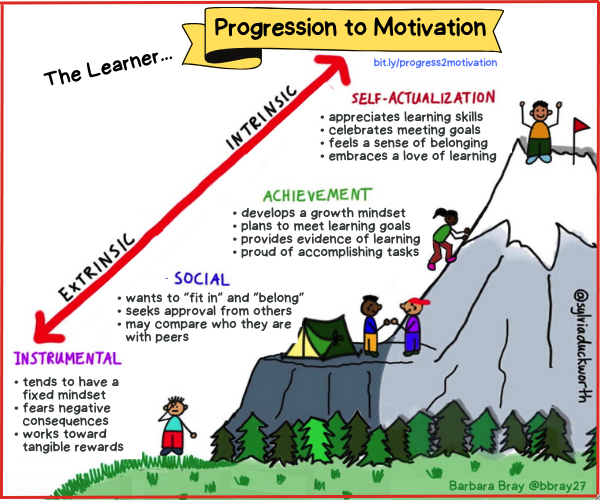
The Progression to Motivation by Barbara Bray (2024) is a derivative adapted from the original continuum and content by Barbara Bray and Kathleen McClaskey (2016) with graphics by Sylvia Duckworth. The content is licensed under a Creative Commons Attribution-NonCommercial-NoDerivatives 4.0 International License.
The Progression to Motivation graphic above is a snapshot of what moving from extrinsic motivation to intrinsic motivation might look like as learners progress through the learning process. I updated the original content to add ideas that demonstrate the learning process and how learners can build confidence as they climb to the top of the mountain to self-actualization.
Extrinsic motivation occurs when we are motivated to perform a behavior or engage in an activity to earn a reward or to avoid punishment. Intrinsic motivation involves engaging in the behavior because it is personally rewarding; essentially, performing an activity for its own sake rather than the desire for some external reward. While some people learn more from outside influences, others may achieve more through their personal aspirations. Motivation has a great impact on the learning process. Whatever the situation, everyone involved in any learning process will probably want to know how motivation affects learning.
Instrumental
 Instrumental is a similar system in education as the factory model that encourages rewards and consequences instead of self-discovery. Most of us are used to this system, and we have become comfortable with it and find it difficult to change. “Students,” especially high school students, may ask questions like “What is my grade?” or “Is this going to be on the test?” Some “students” know how to “DO” school to get through school. Others want to follow the rules, while others are not motivated because they lost interest, do not feel successful, are bored with school, or feel no connections to the teacher, school or learning. I’ve even heard this: “Just tell me what to do to learn.” I call this “learned helplessness.”
At the Instrumental phase, the student may be fearful of change or getting out of their comfort zone, even if they are uncomfortable. The student may not feel they belong or fit in with peers and may be quiet and alone. Or the student could be anxious and irritable about what they are learning or not learning. They could act out and possibly be disruptive. This is a student who needs a champion or someone willing to put time into finding out what other things are happening in their life.
Sometimes it just takes one adult to show they care that makes a difference in a child’s life.
Social
 Social is where students want to be accepted as part of a group, rather than focus on what they are learning. At this level, students may seek the approval of their peers and want to fit in. They do not feel a sense of belonging at this level. They may want to please the people who mean the most to them: their parents, teachers, and peers. They are more motivated by looking good than by focusing on what they are learning. They tend to measure how they perform with others, especially their peers. Friends may mean more to them than what they learn or how they do in school. In this level, they are motivated to learn, driven mostly by extrinsic factors.
In the Social phase, some students follow along with others against their best wishes. They may get into trouble and take responsibility so they are accepted by their peers. They could also be the student who wants to be the “teacher’s pet” and the good friend to others in a clique. They may still have a fixed mindset about who they are and what they can accomplish.
Achievement
 Achievement means learners demonstrate that they want to learn and desire to succeed in and outside of school. This is also where they want to work well and be successful, more than being one of the in-crowd. This is where they may find something they are interested in and want to learn more. They may even create or choose the evidence demonstrating mastery of their learning. When they are more invested in their learning, they want to create learning goals. They may even be excited to show how they met those learning goals. This is where they are developing a growth mindset by believing in themselves. They then realize they can learn if they put their mind to it.
At the Achievement phase, learners are proud of sharing small and big successes with the teacher and parents. The more successes they have, the more they invest in learning to do more. They take more risks and challenge themselves.
Self-Actualization
 Self-actualization is about learners being completely invested in their learning. They are involved and immersed in the learning process because of their love of learning. At this point, a learner’s eyes are open to the idea that it is all about them and how they learn, which drives them to want to learn more. It could be learning a new skill, attaining new knowledge, creating something they never thought they could build, or pursuing their purpose. In self-actualization, they have agency and know they can learn anything they want to learn if they put their heart, mind, and soul into it.
Self-actualization is the complete realization of one’s potential and the full development of one’s abilities and appreciation for life. This concept is at the top of the Maslow hierarchy of needs, and not every human being reaches it. Self-actualized people have an acceptance of who they are despite their faults and limitations, and experience a drive to be creative in all aspects of their lives.
At a higher level, learners may tend to view life as a mission that calls them to a purpose beyond themselves. This transcends self-actualization, and some call that self-transcendence. Realizing one’s potential and focusing on doing for others is a personal endeavor that depends on where the learner’s creative, intellectual, or social potential lies.
****
I want to give a big thank you to Sylvia Duckworth @sylviaduckworth (http://sylviaduckworth.com) from Toronto, Canada, for designing the graphics for the Progression to Motivation
****
Other Websites related to Motivation and Self-Actualization
About the author
