

Stay Connected with Grow Your WHY
Recent Posts

Archives
Didn’t we do this already?


It’s Sunday and a great time to reflect on the last week. All I can say is that it was a whirlwind. Working 12-14 hours every day on Race to the Top proposals, refining our process, talking to different groups about what is and what isn’t personalized learning. The talk always goes back to technology.
It’s not about the technology. It’s about the philosophy you embrace around personalizing learning.
If it’s all about the learner and starting with them, then everything about teaching and learning changes. Technology supports personalizing learning but should not be the focus.
Just putting technology in teachers’ and learners’ hands doesn’t mean they know how to personalize learning. I remember the early days of technology in schools. I believe the late 80s and early 90s, schools built labs called CAI (Computer Assisted Instruction) such as Computer Curriculum Corporation, Success Maker and others.
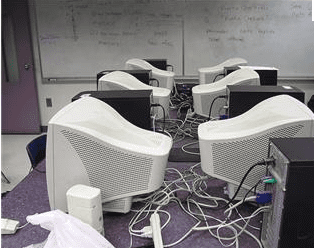 As a technology consultant during those times, I was asked to help build those labs. Most of these labs were built in high poverty schools in rooms that weren’t made for computers. Even the electricity in some of these older buildings couldn’t handle the capacity. They would string together extension cords from other classrooms and hold them in place with duct tape. In some rooms, we had to step over the cord that was 2 feet high. There were some rooms where they moved the computers next to the heaters. Actually, that didn’t matter, because the heaters didn’t work. I needed the work at that time, and that’s where all the money was going. One lab with 50 computers and the software took all the technology budget. There was no money left for training. Only enough to train a paraprofessional who managed the lab. There was no integration with any curriculum in the classrooms.
I observed these labs. Kids loved them in the beginning because it was new, interactive, and included games. They loved the idea of playing in school. The paraprofessionals collected the data and shared with the administration. Scores were going up. The kids rotated through the lab once or twice a week.
But after about six months, kids started talking about how boring it was. One third grade told me that it didn’t matter how he answered the questions so he just hit any key to make it go to the next screen. Scores were at a plateau then dropping. Dropping all over. All the labs. Everywhere. Few years later, the labs were changed. They took off the headphones and brought in technology teachers. Teachers with credentials. Only issue I saw was that they were prep teachers. This meant that there tended to be very little integration of what was happening in the classroom to what was happening in the labs. I know so many of these fantastic computer teachers who did amazing projects. When I was asked to come in, work with the computer teachers, and help integrate technology into the classrooms. Classroom teachers were so busy teaching the curriculum that they didn’t have time or the energy to take the work in the lab and connect it to the classroom. So once again, the work in the labs stood alone and was mostly focused on building isolated technology skills. But there were some amazing computer teachers and librarians who found ways to integrate the skills with projects happening in the classroom.
So now fast forward to today and learning labs to support blended learning rotations. The labs look similar to the CAI of the past and, yes, the scores are improving.
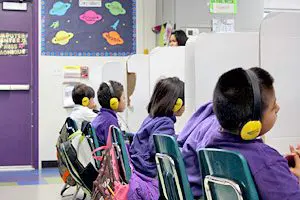
But the real learning that is needed seems to be lost. In some of these environments, the student to teacher ratio has increased because the computers “individualize” the student’s learning and they don’t need as many teachers. Maybe that’s how or why schools are looking at this solution — to save money. Based on algorithms and data, teachers keep track of performance and work with individual students to respond to intervention — to increase scores based on standardized tests. This may sound good to some people, however, to prepare our children for the global workforce, they need different skills then they acquire sitting in front of computers like this. It just cannot be about the scores.
The skills needed for today’s jobs include:
- collaboration and teamwork
- problem-solving
- critical-thinking
- creativity and innovative thinking
- choosing and using the appropriate resources for a task
- building a network of learners locally and globally
- learning how to learn, unlearn, and relearn
Computer labs like the ones some schools are building to blend learning are fitting learning into strict schedules: 20 minutes at one station then move to another station. Real learning doesn’t work that way. We did this already, and it didn’t work. Now we have mobile technology and learning can happen anytime anywhere. Let’s rethink this strategy before we invest millions again into set labs with desktop computers that are just trying to increase scores and use curriculum that adapts to their performance based on algorithms instead of how they learn best.
Personalizing learning needs to be social. It starts with the learner not the technology. Real learning encourages play, creativity, experimenting, taking risks. Learning is supposed to challenge the learner and that cannot happen if they don’t have a stake in it. Learners have a stake in their learning if they have a voice in their learning and are motivated and engaged in the learning. Learners just cannot own and drive their learning when they sit in front of a computer with headphones on clicking through adaptive activities that keep track of their keystrokes.
About the author
