

Stay Connected with Grow Your WHY
Recent Posts

Archives
Episode #137: Collective Intelligence and Human-Centered AI with Johannes Castner


Podcast: Play in new window | Download
Subscribe: Spotify | TuneIn | RSS
Johannes Castner works for several consultancies in Artificial Intelligence (AI) Machine Learning (ML) and Human-Centered Ethical AI as an important sense of collective intelligence. Johannes pivoted CollectiWise as his consultancy around collective intelligence and the Capability Sensitive Design framework for AI.
Your WHY
As a descendant of European Jews as well as Germans, growing up in Germany, I grew up in the shadow of a particularly evil dystopian episode that we are all too familiar with. This episode of history and the great hopes of mostly secular Jewish social and reform thinkers from the 19th and early 20th centuries Germany are the building blocks of my why. We need to consciously build our society towards a utopia of our own making or we will end up being manipulated and stripped of our human dignity.
Your Background
My life story is hard to believe if I hadn’t lived it myself; I went from being a social outcast of sorts in Austria (having been raised in Northern Germany but moved to Vienna as a 12-year-old boy) to being the world’s happiest homeless camper in Los Angeles, to being an Ivy League student graduating magna cum laude from Columbia University in economics and cultural anthropology to working at the Federal Reserve Bank to working in Silicon Valley. All of it is part of a series of ethnographic studies in a way. This is, of course, a very crude bird’s eye view of my past life that only is meant to serve as a backdrop for what I’m doing now: I’m a freelance consultant as a machine learning engineer and data scientist.
Growing up and Moving On
When I was 6, I was sent to a dormitory in southern Germany for troubled kids. I had no education for the six years I was there. My mother took me out of there when I was 12 to Vienna. She homeschooled me in the manner of Summerhill schools in the US. When I was 14, I became an apprentice as a stonemason. I wanted to go to the US so I flipped a coin to choose between New York and Los Angeles. Los Angeles won.
I came to the US as a 19-year-old boy seeking the adventure of a lifetime, and I was not disappointed. I hardly spoke English at the time, and I ended up homeless for some time; the happiest homeless person in America or the world, I believe. After singing in a band and acting in various independent movies as well as being a small-time actor in various TV shows you might have watched for about 5 years.
Your Education
I started studying at Santa Monica College where I took up cultural anthropology and eventually went to Columbia University graduating with a degree in economics. I became a research assistant to the economist Chris Foote at the Federal Reserve Bank of Boston leading to a master’s degree in Sustainable Development at Columbia. I took graduate courses on ethics and game theory at Harvard, while working at the Federal Reserve Bank where I was granted special graduate student status there.
I took a course in experimental and behavioral economics at MIT, working on my first social science laboratory experiment. Amartya Sen’s course on welfare economics and inequality introduced Capability Approach to measuring economic development as human freedom.
Capability Sensitive Design (Virtuous Cycle of Empowerment)
Technology should serve empowerment to implement an ethical AI development and maintenance cycle. This cycle will enable continuous harmonization of ethics; a search for common ground.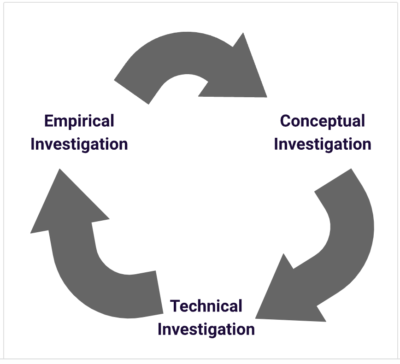
Yet, what those hopes are and how we shall arrive in this world of plenty must be discussed on a global level in order for us to steer the ship and not have the ship float our lives into random and perhaps dystopian waters, determined only by profits.
The Ethical Dilemma of Human-Centered AI
Human-centered ethical AI is in an important sense the dual–the other side of a two-sided coin–of collective intelligence.
In order to build AI ethically, one must consider the deep-seated ethical beliefs on which the world views of the stakeholders are based; unless one is comfortable with being paternalistic. In order to do this one has to build a system that derives its intelligence from the collective that is affected by it.
CollectiWise
CollectiWise was founded in April 2018. The concept is based on the nascent interdisciplinary field of Collective Intelligence, which has an annual conference and a number of academic centers. The objective of CollectiWise is to provide a service, not completely unlike an organization-specific social network, but with the objective to make the organization intelligent, as a collective.
TEDx Talk: Becoming Collectively Intelligent
This talk was given at a TEDx event using the TED conference format but was independently organized during Covid by a local community, in April 2021.
The more creative and human-centered paradigm of collective intelligence has yet to generate the buzz that it deserves. There are many new technologies and platforms geared toward communication and collective interactions. I will discuss why most of them lead us toward collective madness rather than collective intelligence. I will then point out some design principles that can help us to build platforms for collective problem solving and that could help us to realize the potential for collective intelligence.
Podcast: Utopias, Dystopias, and Today’s Technology
https://podcast.johannescastner.com
I am hosting a new podcast that fills a missing niche in my opinion. Also on YouTube; the inaugural episode or extended trailer:
The podcast is called Utopias, Dystopias and Today’s Technologies and it is all about my why:
AI/ML, the blockchain, and many other nascent technologies are already affecting people’s lives across our planet, yet a discussion as to how these effects play out and whether they produce dystopian or utopian conditions is still largely missing.
Where there are discussions about technology and ethics, they mostly come from decisively western ethical traditions. They are often concentrated not on what is good, but merely on the negative consequences that those technologies might bring and how to avoid the worst.
We expect technologies to solve our problems and catapult us into a future of abundance, improved health, and ecosystems flourishing. Yet, what those hopes are and how we shall arrive in this world of plenty must be discussed on a global level in order for us to steer the ship and not have the ship float our lives into random and perhaps dystopian waters, determined only by profits.
The purpose of this podcast then is to spur an inclusive discussion with expert thinkers who are underrepresented in today’s discussions about these new technologies and what they can achieve or break in our global societies.
Your Focus and Mission
I’m an independent consultant in AI and CI (collective intelligence). I’m also a certified ML engineer for the AWS cloud and a Professional Cloud Data Engineer for the GCP cloud. I can advise on AI strategy with a special focus on ethics and I build systems for organizations; if I believe in their missions. I’m more mission-driven than money-driven, although money helps
In addition to that I’m building a digital course at the moment, on various AI/ML algorithms, as well as the ethics associated with them.
Johannes Contact Information
- Email: johannes@collectiwise.com
- Websites:
https://www.johannescastner.com/
https://www.collectiwise.com/home - Medium:
https://wow-ai.com/event/ethical-dilemma-in-human-centered-ai-36504.html - LinkedIn:
https://www.linkedin.com/in/johannes-castner
https://www.linkedin.com/company/collectiwise/ - Video: Ethical Dilemmas of Human-Centered AI
https://www.youtube.com/watch?v=HSXHtNXJOXw
*****
I hope you enjoyed the conversation with Johannes Castner on my virtual porch. I’ve been wanting to learn more about AI from multiple perspectives. I never realized when we started talking I would learn Johannes was homeless, an actor on ER, and a self-made inspirational innovator. Make sure you check out the post about Johannes’ amazing journey so you have access to his resources and links. Please share this podcast and the post with your friends.
*****
About the author
