

Stay Connected with Grow Your WHY
Recent Posts
Archives
UDL Guides Personalizing Learning to Meet the Common Core


by Barbara Bray and Kathleen McClaskey
Universal Design for Learning (UDL) is used to design curriculum, lessons and instruction based on the diversity of the learners in their classroom. The three principles of UDL are:
- multiple means of representation
- multiple means of expression and action
- multiple means of engagement
When a teacher understands his/her learners through the UDL lens, he/she creates a flexible learning environment and provides opportunities for learner voice and choice. When lessons are designed using the UDL model, the lesson includes goals, methods, materials, tools, and assessments to reach and support the maximum amount of learners in the classroom.
Learners can use this model to help them understand how they learn best and what learning path they can take to become an independent expert learner, leveraging their natural abilities in the process. This process helps the learner create their personal learning profile that is understood by both teacher and learner.
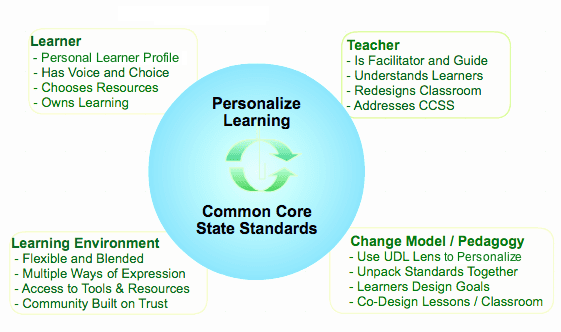
The importance of this strategy is that both the teacher and the learner understand who the learner is and how they learn best. The learner and the teacher uses the UDL lens to personalize learning. So what does that look like? Here are two eighth grade students and their Personal Learner Profiles.
Susan
-
- is an avid reader, likes to write descriptively, and enjoys drawing.
- is anxious when she speaks in front of others.
- forgets the sequence, moral and message of the story.
- wants to ask questions but is uncomfortable voicing her concerns.
- works better individually or in a small group.
Justin
-
- reads and writes at a third grade level.
- requires projects to be broken down into smaller segments.
- has a difficult time organizing and little ability to interpret concepts.
- needs to know purpose behind reading assignments.
- loves to draw and is interested in multimedia.
For US History, eighth graders study the Civil War. There is so much information on the Civil War. The teacher and learners needed to choose one essential or anchor standard. In this case, they determined that the main issue learners had problems with was analyzing text and making connections to a concept.
Essential or Anchor Standard
> Key Ideas and Details (Informational Text)
RI.8.3. Analyze how a text makes connections among and distinctions between individuals, ideas, or events (e.g., through comparisons, analogies, or categories).
After determining the essential standard, the teacher and learners identified supporting standards for the history topic: Civil War. The power of using historical information such as primary and secondary sources is that learners can use visual information in multiple forms to understand the concept. They also were going to choose one subtopic to do a short project.
Supporting Standards
> Integration of Knowledge and Ideas (Integration of History)
RH.6-8.7. Integrate visual information (e.g., in charts, graphs, photographs, videos, or maps) with other information in print and digital texts
> Comprehension and Collaboration (Speaking and Listening)
SL.8.1. Engage effectively in a range of collaborative discussions (one-on-one, in groups, and teacher-led) with diverse partners on grade 8 topics, texts, and issues, building on others’ ideas and expressing their own clearly.
> Research to Build and Present Knowledge (Writing)
W.8.7. Conduct short research projects to answer a question (including a self-generated question), drawing on several sources and generating additional related, focused questions that allow for multiple avenues of exploration.
> Presentation of Knowledge and Ideas (Speaking and Listening)
SL.8.5. Integrate multimedia and visual displays into presentations to clarify information, strengthen claims and evidence, and add interest.
After the teacher and learners chose the standards, they brainstormed questions about the Civil War. They worked in pairs to prioritize questions until they chose one essential question.
Essential Question
What are the causes of the Civil War?
Learners then paired with another learner to come up with supporting questions. The pairs prioritize those questions until they came up with one question that they will research and answer for their project.
Supporting Questions:
- Why did southern states secede from the union?
- What events or publications sparked the start of the Civil War?
- Was slavery the main issue for the war’s beginning?
- What other factors contributed to the civil war beginning?
- If slavery began in 1619, why did it take 200 years for it to become an issue?
- Why did the South believe that they needed to continue slavery?
The learning strategies Susan and Justin used were based on their learner profiles to help them meet the Common Core and demonstrate what they know and understand. Because Susan and Justin understand how they learn best through their UDL lens, they were able to make choices for themselves. Those choices included how they access information, how they are engaged with the information, and how they like to express what they know.
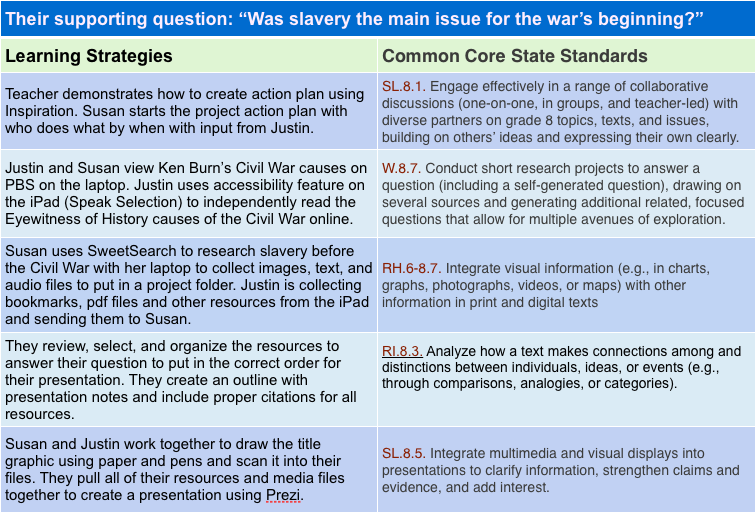
To personalize a unit of study like the Civil War, it is more than just memorizing battles, events, people, places, and times. The essential and supporting questions push the investigation of history further. This project encourages diverse learners to own and direct their own learning about the Civil War. Susan and Justin have diverse learning challenges, yet both of them have a passion for drawing. Because they were able to choose how they respond to the question, they were more motivated to design a title graphic and a Prezi presentation that utilized their creative talents. They were responsible for their learning by choosing the question, the direction of their presentation, and which one of them did each of the tasks to complete their project.
Universal Design for Learning is the guide for schools for personalizing learning to meet the Common Core State Standards.
About the author
