

Stay Connected with Grow Your WHY
Recent Posts
Archives
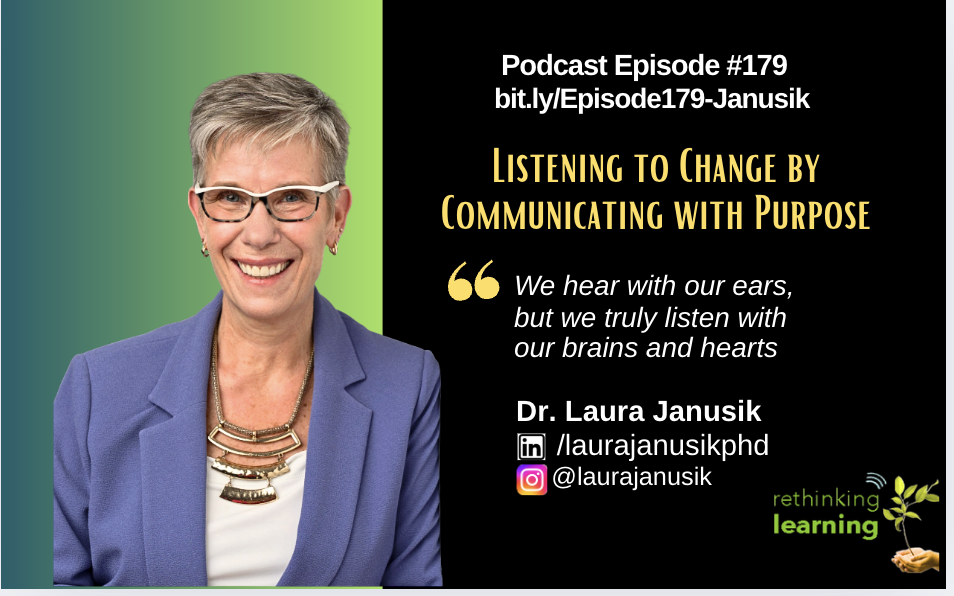
Listening to Change by Communicating with Purpose with Dr. Laura Janusik (EP179)


Podcast: Play in new window | Download
Subscribe: Spotify | TuneIn | RSS
With over 20 years as a listening expert and researcher, Dr. Laura Janusik empowers caregivers, leaders, and growth seekers to build stronger, more compassionate relationships. Transforming workplace communication through training and workshops, Laura guides caregivers navigating cognitive decline. Laura’s work is rooted in the science and practice of listening, helping people connect with clarity, patience, and understanding in every part of life.
Your WHY about Listening
I took my first listening course in my master’s level program because my mentor, Dr. Andrew Wolvin, was a listening scholar. I knew he’d be writing my letters of recommendation, so I figured that if I showed a little interesr of his passion, the letters might be better. Within 2 weeks of that class, my life had changed! I couldn’t believe what listening actually was, and how I had been the world’s worst listener for over 30 years!
When I realized that the quality of listening determines the quality of the relationship, I was hooked!
I, too, became a listening scholar, and my passion has been to help people develop better personal and professional relationships through the power of listening.
Most communication problems aren’t about what we say; they’re about how our brains listen.
I help business leaders, caregivers, and coaches strengthen their communication through neuroscience-based listening strategies. When you understand how the brain processes messages, you can create connections, reduce stress, and build trust in every conversation.
Listening to Change, LLC

Listening to Change helps Coaches, Leaders, Executive Leadership Teams, Sales Teams, Groups, and Individuals listen and speak with purpose to increase shared understanding, decrease time on projects, and build a positive company culture. Consulting, training, and coaching are customized for each client.
- Create Alignment
- Deepen Connections
- Grow through Action
Why Listening is an Important Skill
Listening takes intention, awareness, and practice, and it appears different depending on who you are and the challenges you face. It is also dependent on the context, including with whom you’re speaking, the purpose of the conversation, and your goal.
Whether you’re leading a team, caring for a loved one, or seeking personal growth through coaching, the right strategies can help you listen more effectively, increase trust, and build stronger, more compassionate connections.
Most people don’t think of listening as being a part of communication. I like to use this equation: Communication = Sending Messages + Receiving Messages. And, most miscommunication occurs because of poor listening, not poor speaking. If we learn to listen even 10% better, our conversations and relationships will improve.
How Listening is Important in Business
Listening is important in business because it’s the best skill to create alignment. It is the skill that helps teams get on the same page and work towards the same goal. A business cannot exist without communication, so it seems counterintuitive to me when a business doesn’t invest in communication training.
Listening is the one skill that influences all of those primary business goals, such as getting projects completed on time, increasing sales, and achieving higher customer satisfaction.
There are two best ways someone can develop better listening in business. The first is through coaching, and the second through team training. I work in both areas. I use the ECHO Listening Profile™. as the foundation of either one, and I’m a certified coach for Listening Intelligence. The ECHO is special, as it’s a validated listening assessment that identifies your dominant listening habit and blind spot. I use this instrument because it’s a great way to show people what they are listening to and for, as well as what they are missing. It not only helps individuals; it also helps teams, because the group report is an excellent way to ‘see’ how team members are listening similarly and differently.
Aren’t Most Coaches Good Listeners?
Most coaches are better listeners than the average person, but that doesn’t mean that they can’t improve. As a coach myself, I know that it’s a great way to help clients build their confidence. I help coaches with tiny tweaks rooted in neuroscience so they can help their clients listen better to their inner wisdom.
How did you get involved with Caregivers and the focus on listening?
My Mom was diagnosed with cognitive decline about 10 years ago, and I promptly did what most children do…nothing! I figured she had dealt with and conquered all of her health ailments, and she would do the same with this one, too. Fast forward 5 years to when she got COVID, which really exacerbated her dementia. As the only surviving child, I knew I needed to step in. Communicating with her was frustrating because she didn’t understand what I was asking her, and she often repeated herself.
I realized that if a PhD in Communication couldn’t develop a good relationship with her Mom in dementia, then who could?
With communication theory and brain science, I created a workshop to help others reduce their frustration and increase their connection. It’s been a game-changer for everyone who has taken the workshop!
What are your two workshops around listening for Caregivers?
The first is for the child, spouse, or other who wants to support their loved one with cognitive decline: The Caregiver’s Starter Kit: A 3-Part Workshop to Learn What No One Tells You About Communication and Dementia.
The second is the family or group, and it’s called The Caregiver’s Village: A 90-minute workshop for caregivers and friends who want to help but aren’t sure how. The best way to learn more about when these workshops will be offered is to sign up for my email list. You can do that from the “Stay Connected” section of my website’s homepage.
Practical Tips for Listeners
Many listening tips can be found on my YouTube channel, Listening to Change by Laura Janusik. However, please give me grace, as I began the channel without knowing what I was doing with that technology.
One of my favorites is When’s the Last Time Someone Said You Were a Good Listener? because I give you a challenge at the end of the video. Try it!
Here are some of my best tips…
Tips for Leaders on Listening:
- Your direct reports and colleagues don’t know you’re listening unless you respond verbally. Learn the skill of confirming (paraphrasing + asking if you’re right) to increase trust.
- Following through is critical. Employees don’t expect you to make all of the changes they expect. Follow through later by letting them know where you took the suggestion and what was decided. I guarantee that employees who get follow-through continue to bring good ideas!
- Communication for Leaders: Fact or Myth? Test Your Knowledge! Sign up Leaders Mailing List.
Tips for Coaches on Listening:
- The most important listening strategy to use is silence. Silence allows your client time to think.
- No matter what you call it…summarizing, paraphrasing, confirming, or reflecting…when your client hears back what they just said, they have many a’has!
- Communication for Coaches: Fact or Myth? Test your Knowledge! https://mailchi.mp/ff5ac1ab3c8c/95lzskl7mo
Tips for Caregivers on Listening:
- The 2-minute pause is a game-changer. It can take up to 2 minutes for someone with cognitive decline to respond to a question. When we re-ask the question, the clock begins again. Caregivers need to learn to practice silence about all else.
- Self-care isn’t selfish. It’s strategic. It’s sipping tea. It’s journaling. It’s taking a walk. Take care of yourself so you can take care of your loved one.
- Weekly Tips and Tricks for Caregivers: Mailing List
What’s Next
I’m currently writing a book loosely titled, How to Manage Conflict within the Context of Midwest Nice. Conflict avoidance and passive-aggressive behavior are huge in the Midwest, and being ‘nice’ gets in the way of honesty and real connection. I’m going to advocate not losing all of the nice, but focusing more on the kind. Think about that. What’s the difference between someone who is ‘nice’ and someone who is ‘kind’ to you?
Laura’s Contact Information

LinkedIn: https://www.linkedin.com/in/laurajanusikphd/
Website: ListeningtoChange.com
Facebook: https://www.facebook.com/profile.php?id=61576655810327
Instagram: https://www.instagram.com/laurajanusik/
Email: info@listeningtochange.com


****
I am so glad that Dr. Laura Janusik joined me on my virtual porch. Laura sat next to me during several sessions at the International Listening Association (ILA) Convention, August 2025. I connected with Laura right away and wanted to follow up with her. Several times, I realized that Laura had been a member of the ILA for a long time and been president of the organization. So I figured if I had questions about the conference, I’d ask her. She was really easy to talk to and helped me whenever I had questions. We connected after the conference several times, and then I checked out all the resources she shared with me. As a coach and in developing my listening skills, Laura opened doors for me that I wanted to share with you. I hope you enjoyed our conversation as much as I did. Please share this post and podcast with your friends, and make sure you connect with Dr. Laura Janusik.
*****
About the author
