

Stay Connected with Grow Your WHY
Recent Posts
Archives
Episode #118: Unlocking the True Potential in Kids with Dr. Daniel Fried


Subscribe: Spotify | TuneIn | RSS
Dr. Daniel Fried, Assistant Professor in Chemistry at Saint Peters University, has developed new methods and content for chemistry education in K-12 that incorporates pedagogies from Daniel’s background in music and art. It’s very visual, tactile, and kids learn the concepts in a way that mirrors how students learn musical instruments.
Your Background
I grew up in Kingston, New York, and attended SUNY Binghamton as a Biochemistry major. I then completed my MS and Ph.D. in Chemistry at Yale University, where I worked in the laboratory of Alanna Schepartz and helped develop technology for fluorescent sensing of protein folded state. I then completed a post-doctoral fellowship in the laboratory of Ed Bayer at the Weizmann Institute of Science in Israel, where I worked on a green energy project involving bacterial enzymes. I’m now an assistant professor of chemistry at Saint Peter’s University in Jersey City. I’ve worked extensively to develop a methodology to bring high-level chemistry and biochemistry to kids.
What was it like for you as a student?
I was involved in music, art, and science as a kid. I was always torn about what career to pursue. I had great teachers in school, but as a child of two elementary school teachers, I had a tendency to analyze the curriculum I was using, as well as school culture itself. I always had the feeling that I wanted to create my own school someday but wasn’t totally sure what would be special about it.
What or who inspired you to focus on Chemistry?
I stumbled on chemistry while taking Organic Chemistry over the summer in college. I loved how the subject finally gave explanations about how living matter is put together and how it reacts. I started taking more courses in organic and biochemistry because I wanted to know how everything in the biological world was structured!
Can you tell me more about your research on engineering protein and enzymes?
During graduate school, I helped develop a technology that used fluorescent dyes to monitor the folded state of proteins. This technology could be applied to the study of all kinds of problems in medical research where protein folding issues are involved. During my postdoc, I worked on the cellulosome, which is a very large bacterial enzyme complex that is involved in the digestion of cellulose, the main component of plant fiber. Cellulosomes digest fiber and release sugar, which could be fermented to produce liquid fuel. The research, therefore, relates to the development of renewable energy solutions.
Why did you want to develop content for chemistry education for K-12?
At the end of graduate school, and with a Ph.D. in chemistry, I felt that I had a birdseye view of the subjects of chemistry and biochemistry, and wanted to go back to fill in the gaps and try my hand at revolutionizing the subject for early learners. I didn’t want other kids to get stuck the way I did. I also wanted to show that kids have an untapped potential that wasn’t acknowledged with the standard approaches to learning that I experienced as a kid. I didn’t think that kids should have to wait until they were adults to find out about biochemistry. I wanted to see if kids could learn it from an early age.
You have to talk about your courses and resources for BioChemistry Literacy.
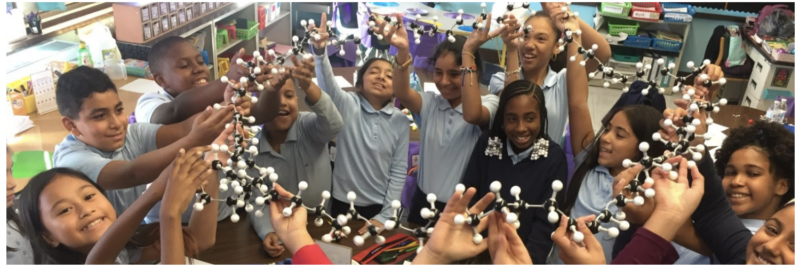
My Biochemistry Literacy program incorporates pedagogies from my background in music and art, so it has some unique features. It’s very visual, tactile, and kids learn the concepts in a way that mirrors how students learn musical instruments. I developed the program over many years working in public and private schools in the New York area. I make all my materials available on my website for schools and homeschoolers to access. The program covers an introduction to chemical bonding, the periodic table, acid/base chemistry, hydrogen bonding, protein folding, and an in-depth study of the great biomolecules that make up the natural world. The amazing thing about it is that kids as young as 6 years old can begin engaging in serious college-level content. I’m aiming to prepare kids of all ages for things like Advanced Placement Biology and Chemistry, but really I want to inspire them to learn science and connect them to biochemistry. The standard curriculum seems to discourage the early study of the molecular world, but this program embraces it.
https://biochemistryliteracyforkids.com/
What’s next for you?
We now have a small army of elementary school students who are “graduating” from the Biochemistry Literacy program after a year of study. They know as much, if not more, as typical pre-med undergraduates in these subjects. I’ve decided to continue working with them in a full-scale college-level organic chemistry course, so by next year, we’ll be at an even more impressive level. We also really need to get the word out about the success of the program so that more kids can have access to it. The methodologies that I use could be deployed by teachers everywhere to remodel K-12 science education and better prepare kids for the future.
Daniel’s Contact Information

Email: daniel@biochemistryliteracyforkids.com
About Daniel https://www.saintpeters.edu/academics/faculty/members/daniel-fried/
Twitter: https://twitter.com/DanielFried2
YouTube: https://www.youtube.com/channel/UCJx2v6EpmDAjoRdrjgzMIHQ/videos
FaceBook: https://www.facebook.com/biochemistry.literacy.for.kids/
LinkedIn: https://www.linkedin.com/in/daniel-fried-705bb373/
****
Podcast: Play in new window | Download
About the author
