

Stay Connected with Grow Your WHY
Recent Posts
Archives
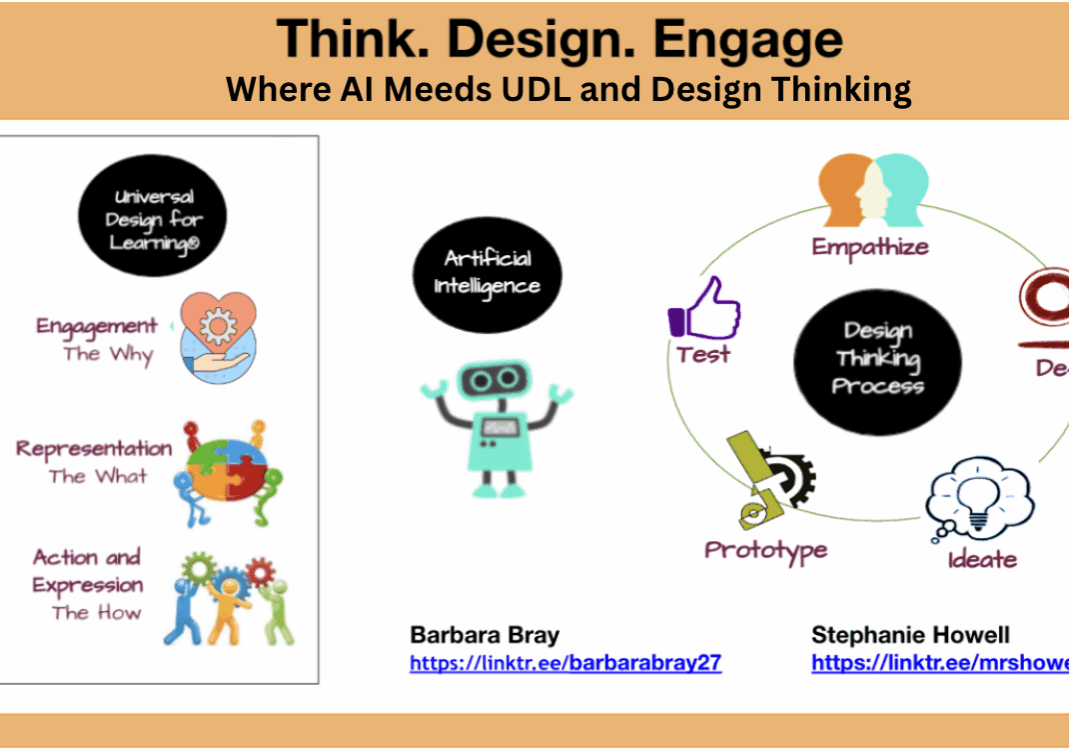
Think. Design. Engage: Where AI Meets UDL and the Design Thinking Process


By Barbara Bray and Stephanie Howell
Stephanie Howell and I decided to create a planning tool using the Design Thinking Process, Universal Design for Learning (UDL), and AI. In deciding what resources you need based on the learners you have, you may first need to determine how your learners learn best, what lesson or activity you plan to focus on, how design thinking can support the process, and which AI tools you include in a lesson or activity. We updated a previous planning tool for AI that I co-created with Jackie Gerstein on makerspaces. [source]
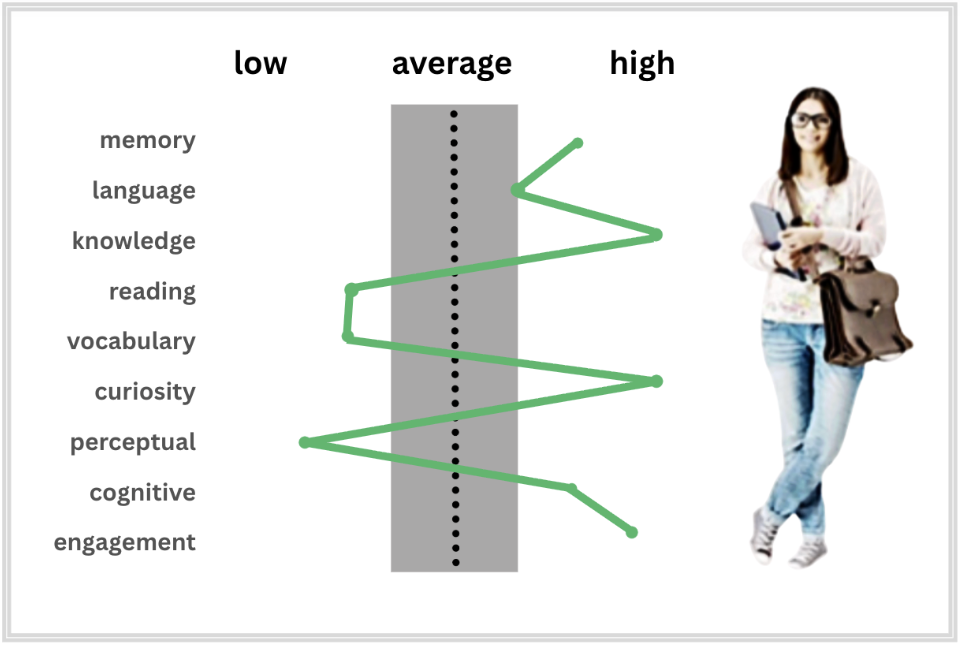
There is no “average” brain
The assumption that metrics comparing us to an average—like GPAs, personality test results, and performance review ratings—reveal something meaningful about our potential is so ingrained in our consciousness that we don’t even question it. That assumption, says Harvard’s Dr. Todd Rose, is spectacular—and scientifically wrong. [Source]
“If we overcome the barriers of one-dimensional thinking and demand that social institutions value individuality over the average, then we will change the way we think about success– not in terms of our deviation from average, but on the terms we set for ourselves.”
Dr. Todd Rose, author of The End of Average
From Todd Rose’s Project Variability, he states that “even though we have the most diverse population in the world, we are unable to exploit this natural advantage in human capital.” Four percent of dropouts in the US are intellectually gifted. That comes up to 50,000 minds each year who don’t fit in the average model. How much of this is bad design? We design learning environments for the average learner. We call our system age-appropriate, but it is not. Learners vary on many dimensions of learning.
Universal Design for Learning (UDL)
UDL is based on principles that empower everyone to have agency over their own learning. It enables educators and learners to establish clear goals, anticipate potential environmental barriers, create meaningful options, and fully embrace human diversity.
Center for Applied Special Technology (CAST)
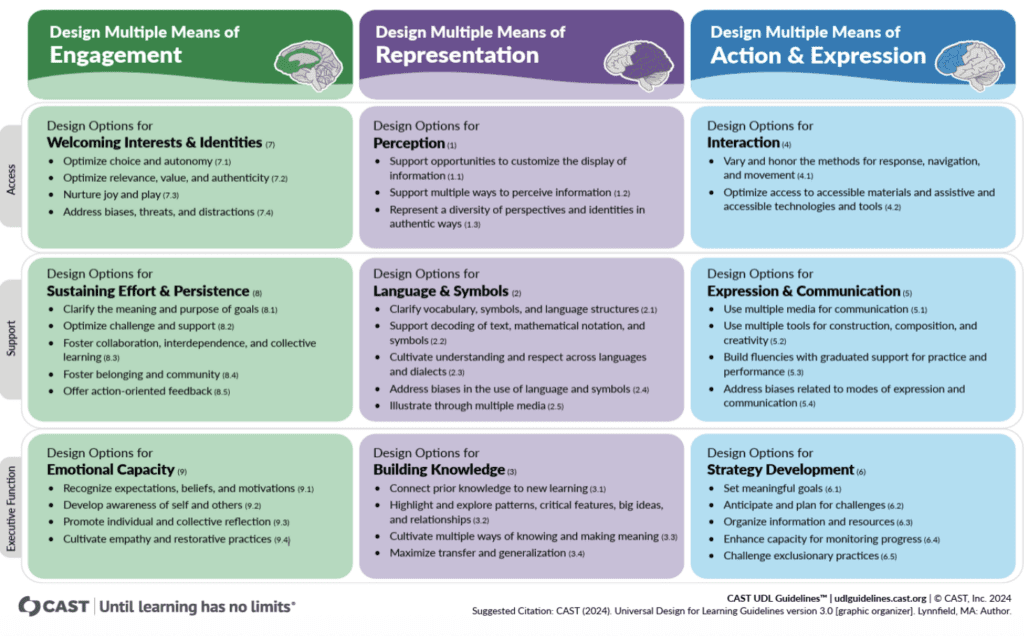
Universal Design for Learning (UDL), developed by David Rose and Ann Meyers of the Center for Applied Special Technology (CAST). The goal of the updated UDL 3.0 is learner agency.
- Multiple Means of Engagement The WHY of Learning): purposeful and reflective.
- Multiple Means of Representation (The WHAT of Learning): resourceful and authentic.
- Multiple Means of Action and Expression (The How of Learning): strategic and action-oriented.
http://www.cast.org/our-work/about-udl.html
The National Center on Universal Design for Learning refers to the alternate version of the UDL Guidelines found in the book UDL Theory and Practice by David Rose and Ann Meyers. Starting with the WHY of Learning, the UDL 3.0 Guidelines take you on a deep dive into each of the principles, using checkpoints that provide resources, examples, and research.
The Design Thinking Process
Design thinking is an approach to learning that includes considering real-world problems, researching, analyzing, conceiving original ideas, experimenting, and sometimes building things by hand. This process guides students to consider the needs of others, solve challenges, overcome setbacks, and stay motivated to learn. The process also teaches students to build on the ideas of others, vet sources, generate questions, deeply analyze topics, and think creatively and analytically. The Design Thinking Process includes five phases: Empathize, Define, Ideate, Prototype, and Test.
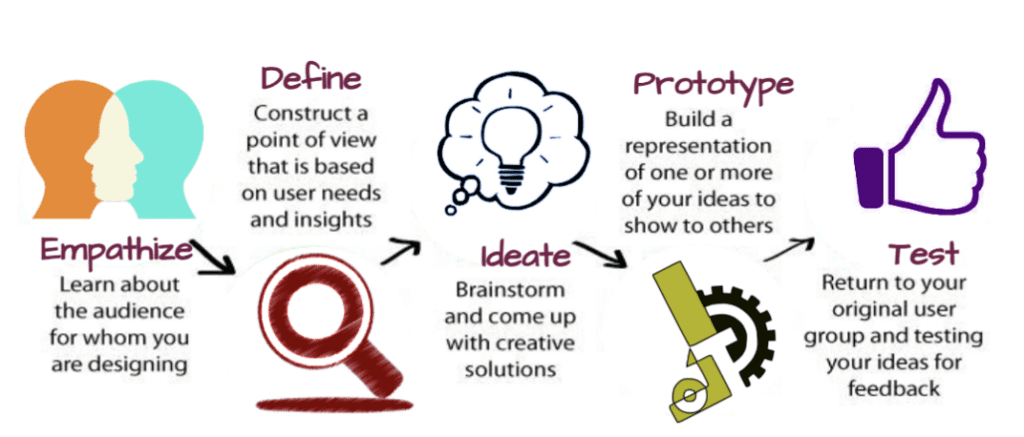
https://dschool.stanford.edu https://designthinking.ideo.com/
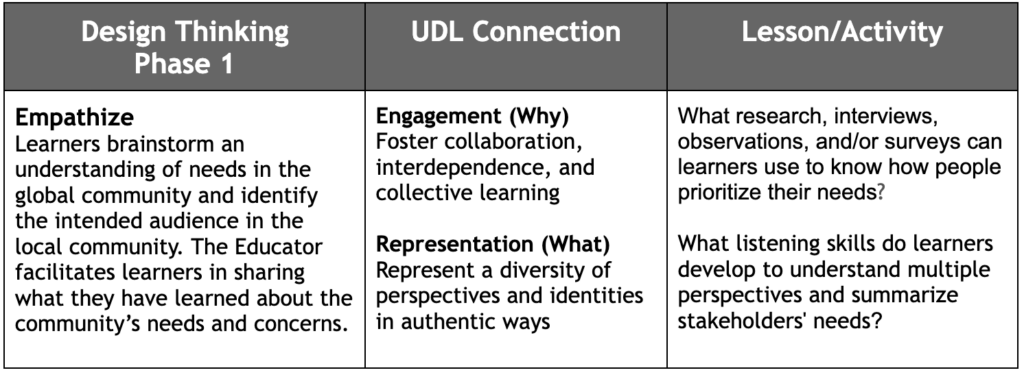
Design Thinking 1. Empathize + (UDL) Engagement/Representation
To create meaningful innovations or solutions, you need to know your audience and care about their lives.
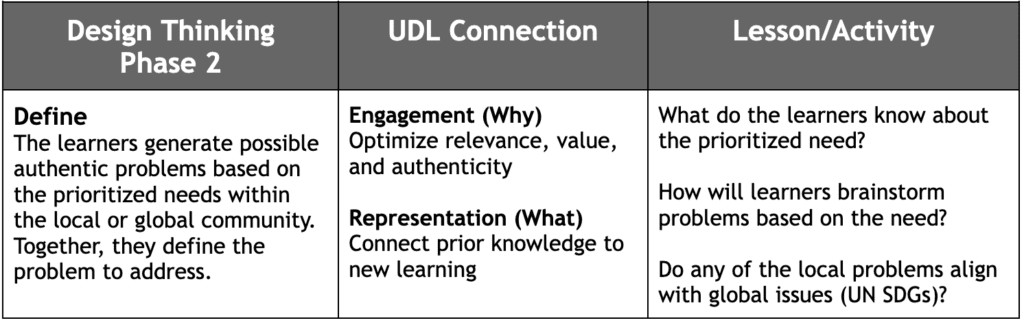
Design Thinking 2. Define + (UDL) Engagement/Representation

Framing the right problem is the only way to create the right solution.
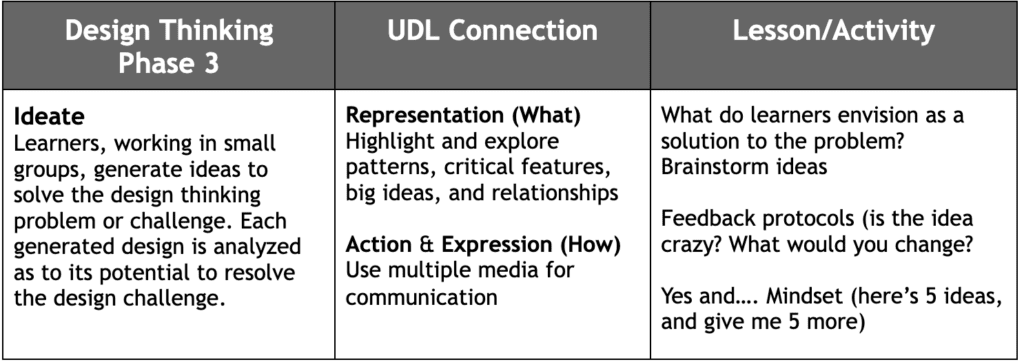
Design Thinking 3. Ideate + (UDL) Representation/Action & Expression
It’s not about coming up with the ‘right’ idea. It’s about generating the broadest range of possibilities.
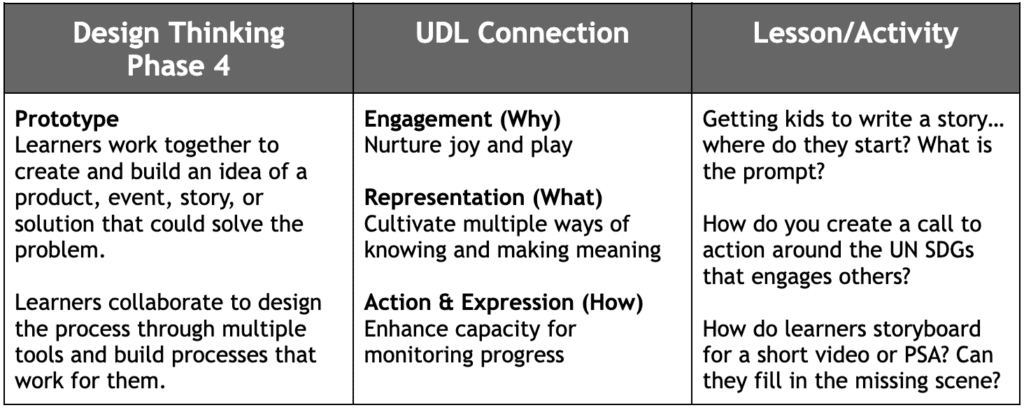
Design Thinking 4. Prototype + (UDL) Engagement/Representation/Action & Expression
The prototype is the iterative generation of artifacts intended to answer questions to get you closer to your solution.
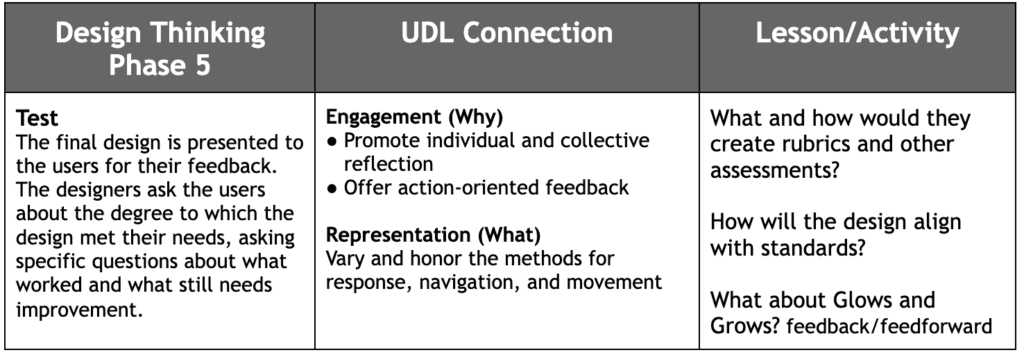
Design Thinking 5. Test + (UDL) Engagement/Representation

Testing is an opportunity to learn about your solution and your users and invite feedback.
Digital Tools in the Learning Backpack

Review the AI programs, online tools, and Google Doc templates using any of the examples of activities mentioned above. Choose any of the apps or tools you believe will enhance your lessons and engage your learners to add to your Learning Backpack.
| Apps/Tools | Activities/Templates |
| Figma Notebook LM ChatGPT SchoolAI Gemini Padlet Thinglink Canva | Crazy 8’s Empathy Map Generate Sort Connect Elaborate Thinking Hat activity Gripe Jam Why’s KWL |
Below are two Google Docs using AI with detailed activities:
Using AI to Strengthen Authenticity in PBL (Activities)
From Feedback to Glows & Grows by Greta Sandler
Now it’s your turn!
Choose a lesson you plan to focus on, how UDL and design thinking can support the process with specific activities, possibly the UN SDGs, and which AI apps or tools you will include.
Design Thinking, UDL, and AI Planning Tool
| Lesson: | |||
| Design Thinking | UDL Connection | Activities | AI/Tools |
| Phase 1: Empathize Learners brainstorm an understanding of needs in the global community and identify the intended audience in the local community. Learners share what they have learned about the community’s needs and concerns. | Engagement (Why) Foster collaboration, interdependence, and collective learning Representation (What) Represent a diversity of perspectives and identities in authentic ways | ||
| Phase 2: Define The learners generate possible authentic problems based on the prioritized needs within the local or global community. Together, they define the problem to address. | Engagement (Why) Optimize relevance, value, and authenticity Representation (What) Connect prior knowledge to new learning | ||
| Phase 3: Ideate Learners, working in small groups, generate ideas to solve the design thinking problem or challenge. Each generated design is analyzed as to its potential to resolve the design challenge. | Representation (What) Highlight and explore patterns, critical features, big ideas, and relationships Action & Expression (How) Use multiple media for communication | ||
| Phase 4: Prototype Learners collaborate on an idea of a product, event, or story that could solve the problem. Learners collaborate to design the process through multiple tools. | Engagement (Why) Nurture joy and play Representation (What) Cultivate multiple ways of knowing and making meaning Action & Expression (How) Enhance capacity for monitoring progress | ||
| Phase 5: Test The final design is presented to users for feedback. The designers ask users about the degree to which the design met their needs, asking questions about what worked and what still needs improvement. | Engagement (Why) Promote individual and collective reflection Offer action-oriented feedback Representation (What) Vary and honor the methods for response, navigation, and movement | ||
Barbara Bray https://linktr.ee/barbarabray27
Stephanie Howell https://linktr.ee/mrshowell24
About the author
