

Stay Connected with Grow Your WHY
Recent Posts
Archives
Building a Culture of Collaboration with Jamie Meola Saponaro (EP186)


Podcast: Play in new window | Download
Subscribe: Spotify | TuneIn | RSS
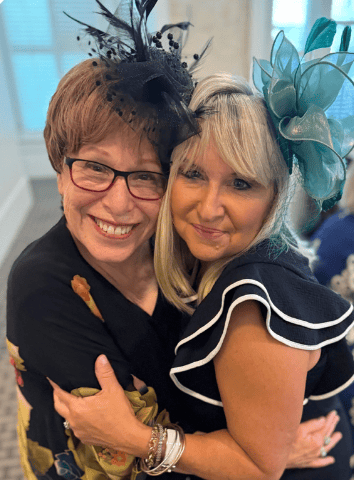
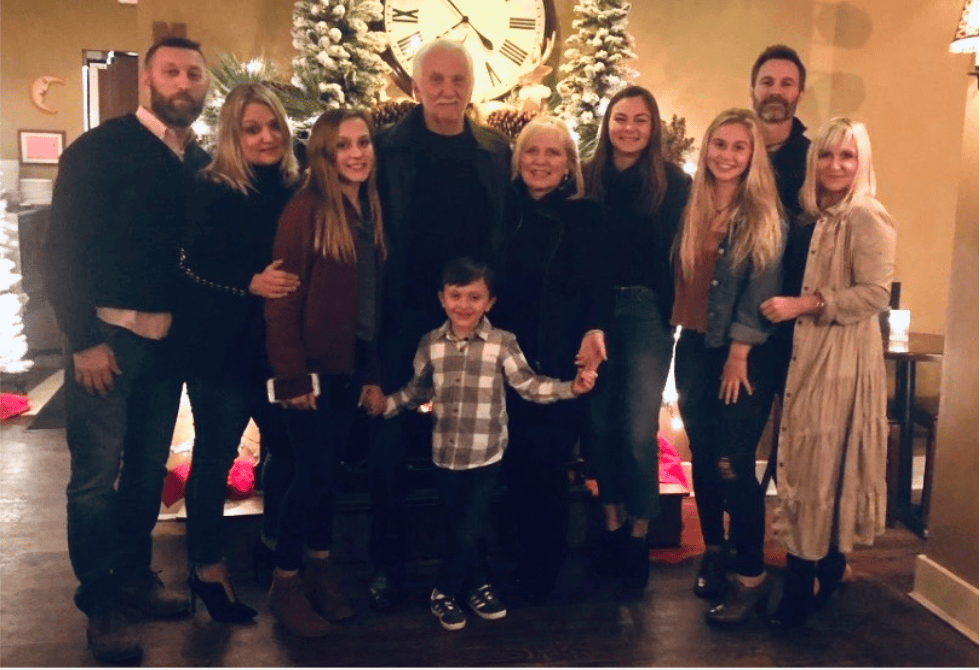
Jamie Saponaro is the Senior Director of Community and Professional Learning at ClassLink. She leads thought leader initiatives that bring educational communities together through summits, webinars, and professional learning events. Jamie is the host of LinkedUp: Breaking Boundaries in Education, a podcast dedicated to spotlighting boundary-breaking educators. She just launched her new book: Transforming Classrooms: Building a Culture of Collaboration. I just had to share a picture of Jamie and me at one of the high teas I mentioned in the podcast.
I always ask my guests to share their WHY. What is your WHY?
My father taught for 37 years – drafting, architectural drawing, woodshop, technology education, video production – and whenever anyone asked him what he taught, his answer was never that he taught any of those subjects – he always said ‘I teach students.’
That shaped everything about how I think about teaching. Are we teaching the ‘curriculum’? Or are we teaching the ‘students’? Students learn through instructional best practices that allow for differentiation. It is not about teaching the ‘stuff.’ It is about teaching and reaching individual learners.
It is about building a community of students and the conditions for unique learning opportunities from not only their teacher, but also from each other.
Can you share an overview of your background?
A Jersey girl coming from a family of educators – my father was a teacher, my mother was a teacher, my husband was a teacher and is now a superintendent – education became my path as well, and I’ve been in it for over 35 years. I taught for a dozen years and then became a technology director. I went on maternity leave to start my family, and during that time, I wrote a book called Creative Projects Using Popular Computer Applications. Then, I founded my own company, InTECHgration, as an instructional strategist and technology integration specialist, providing professional learning for teachers and administrators through coaching, mentoring, and hands-on workshops rooted in research-based strategies and high engagement. I also volunteered as the president and executive board member of an education foundation for 10 years.
Lead of ClassLink’s Thought Leader Initiatives
The industry side of education came knocking, so I gradually took that on full-time and now lead ClassLink’s thought-leader initiatives that promote community building and professional learning for educational leaders through in-person and virtual summit events in pursuit of “linking leaders.”
I am also the co-host of the podcast, “LinkedUp: Breaking Boundaries in Education,” and produce the podcast, “Perspectives: Finding Common Ground,” and additionally produce and host 3 webinar series. As for the rest of my family, my sister was the only one not in education, and my older daughter, Bella, followed in her footsteps in the fashion world. My other daughter, Lauren Rose, is an avionics product designer who is also my graphic designer for my second book, Transforming Classrooms: Building a Culture of Collaboration.
What Your Book Shares with Teachers and How it Transforms Classrooms
Most educators I have worked with have tried group work, and it failed every time. One student does all the work. Another disappears. A third turns it into a fight. The rest just wait for it to be over
What I want teachers to know is that it is not a flaw in their abilities. It’s actually a design flaw.
Group work fails because it was never designed to work. There is no structure requiring every voice, no accountability that reaches every student, no reflection that builds the skill for next time. Without those elements, we are not doing cooperative learning. We are just putting children in proximity and hoping for the best.
Cooperative learning is different. It is a research-backed structure with 70 years of evidence showing it outperforms individual learning at a statistically significant rate — but only when all the components are present. When we implement it with fidelity, students do not just complete tasks together. They think together. They teach each other. They learn how to belong.
Cooperative learning is different. It is a research-backed structure with 70 years of evidence showing it outperforms individual learning at a statistically significant rate — but only when all the components are present. When we implement it with fidelity, students do not just complete tasks together. They think together. They teach each other. They learn how to belong.
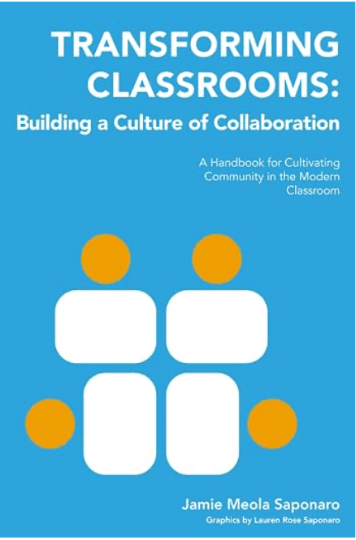
That distinction is the entire foundation of my book Transforming Classrooms: Building a Culture of Collaboration.
I have seen it work so beautifully for students and seen classrooms flourish because of it, so I wrote the book to share the tips and simple tweaks to turn group work into true cooperative learning.
_________________
The Foundation: Five Pillars of Cooperative Learning (TEAMS)
To make cooperative learning stick — and to help educators remember what makes it work — I anchor the five research-backed pillars in the acronym TEAMS.
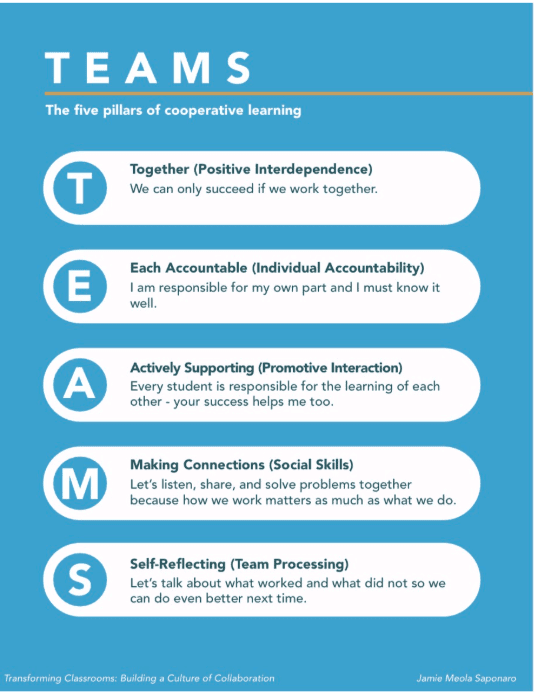
T — Together (Positive Interdependence): We succeed together. No one coasts, no one carries everyone.
E — Each Accountable (Individual Accountability): Every student has a real role. Coasting becomes impossible.
A — Actively Supporting (Promotive Interaction): Students help each other succeed — not just sit near each other.
M — Making Connections (Social Skill Development): students use active, listening, and productive talk to build the skills needed to properly communicate.
S — Self-Reflecting (Team Processing): Teams pause and ask what is working and what needs to change.
Each intentional design component is needed for the structure to work. Remove any one letter, and it becomes flawed group work.
_________________
The Practice: Cooperative Learning Strategies
The book includes over 40 cooperative learning strategies that are organized by usage of convergent vs divergent thinking as well as where each would fit within a lesson. They are grouped in a matrix and act as a menu to choose the right structure for the right moment. Technology in the classroom has become synonymous with cheating, shortcuts, and students outsourcing their thinking to a chatbot instead of doing it themselves. That worry is valid. But the answer is not to ban the tool. It’s to design the structure around it.
An additional specialized framework that considers the integration of technology that I developed is called QUEST.
_________________
QUEST is a five-stage framework for collaborative inquiry, design-thinking, and purposeful technology use within problem-based learning.
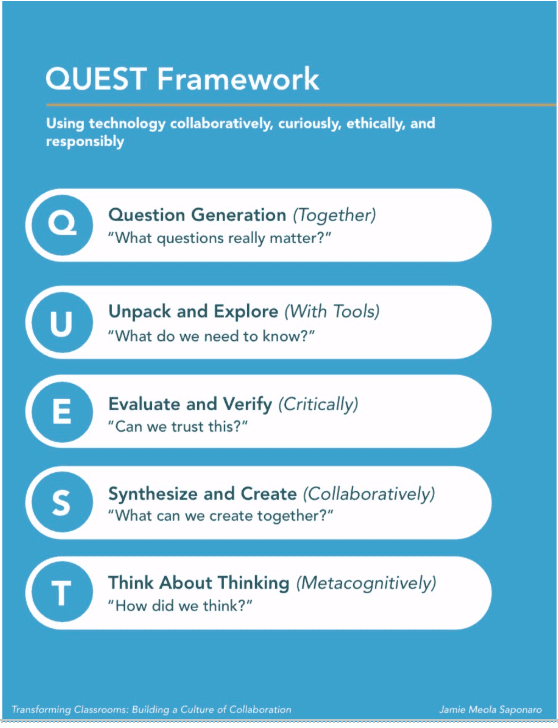
Q — Question Generation — where students generate their own questions first, individually, then as a team, from their own curiosity and prior knowledge. Human thinking has to come before any tool or research.
U — Unpack and Explore — where teams research using multiple sources, and yes, AI tools are now a part of this phase. There are roles involved that are part of the structured cooperative learning.
E — Evaluate and Verify — and this is the AI literacy component. Teams apply what I call the ABCD Check to every source they find, including AI-generated content: Is it Accurate? Is there Bias? Is it Complete? Is it directly relevant? This phase is not consumption of information – it is an interrogation of it.
S —Synthesize and Create — where teams take everything they have gathered, evaluated, and debated, and build something new together through genuine consensus and individual accountability ( the skills developed through ongoing cooperative learning). The PBL end product has to reflect every team member’s thinking — not just whoever talks the most.
T —Think About Thinking – metacognition. Teams reflect on how they collaborated, not just what they produced.
The whole model is built on the belief that technology should be a collaborative thinking partner, never a replacement for thinking.
This framework gives teams of students the structure to use design-thinking and critical thinking to go on a problem-based learning “QUEST” collaboratively without losing their own voice in the process.
The most important element in any classroom has always been the human beings in it. TEAMS and QUEST are structures, but the goal underneath them is about helping students think, connect, and grow collaboratively to prepare them for the future ahead.
_________________
Jamie Saponaro‘s Contact Information

LinkedIn: https://www.linkedin.com/in/jamiesaponaro/
Emails: intechgrationed@gmail.com
jsaponaro@classlink.com
*****
About the author
