

Stay Connected with Grow Your WHY
Recent Posts
Archives
Design Thinking Process and UDL Planning Tool


Bringing Makerspaces into Classrooms to meet STEM and STEAM
Post by Jackie Gerstein, Ed.D. @jackiegerstein, and Barbara Bray @bbray27
If there is a makerspace in your school, it may be down the hall, in the library, or in another building. If there is someone other than the teacher managing the makerspace or there is a schedule for the school, your kids may only be able to use it once a week or month. Some makerspace activities may be focusing on how to use the resources available and may not be connecting the activities to the curriculum or around a real world problem. If this is how the makerspace is set up in your school, then your kids may not have access to the resources, materials, and tools when they need them, especially for STEM or STEAM.
In deciding what resources you need based on the learners you have, you may first need to determine how your learners learn best, what projects you plan to do, how you can set up a makerspace in your classroom, and much more. This is why we decided to create a planning tool for makerspaces in the classroom for you using the Design Thinking Process and Universal Design for Learning®.
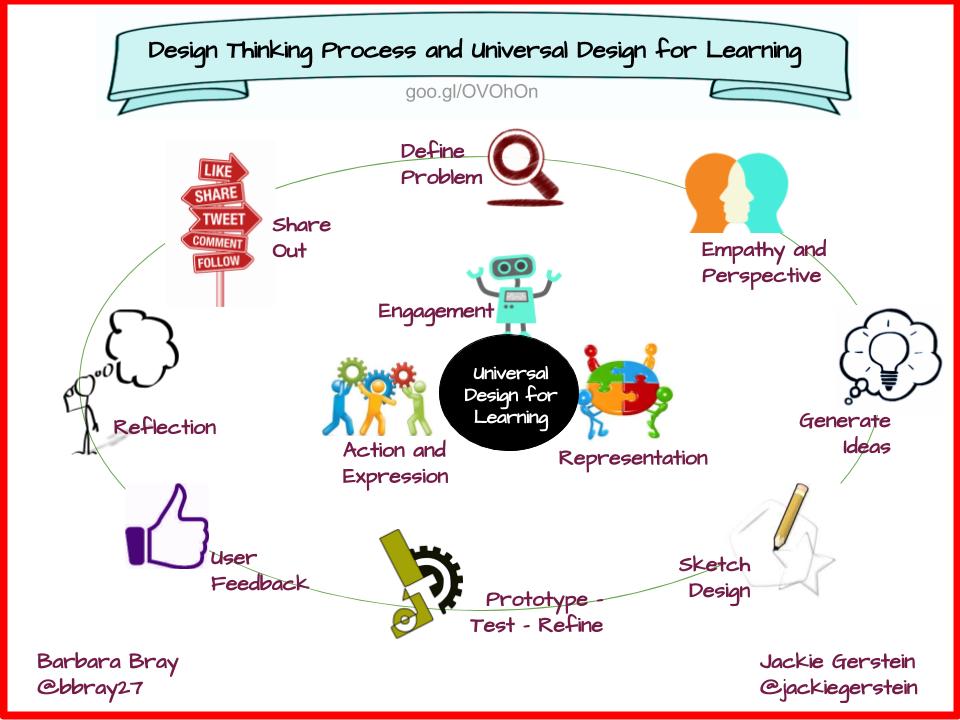
The Design Thinking Process
Design thinking is an approach to learning that includes considering real-world problems, research, analysis, conceiving original ideas, lots of experimentation, and sometimes building things by hand. The projects teach students how to make a stable product, use tools, think about the needs of another, solve challenges, overcome setbacks and stay motivated on a long-term problem. The projects also teach students to build on the ideas of others, vet sources, generate questions, deeply analyze topics, and think creatively and analytically. Many of those same qualities are goals of the Common Core State Standards. (What Does ‘Design Thinking’ Look Like in School?)
We adapted the Design Thinking Process to include additional phases based on our own experiences in schools with educators and kids.
 Define the Problem: The educator along with the learners generates possible authentic problems to explore within their local community (classroom, school, social, community) which includes identification of the intended audience.
 Empathy and Perspective Taking: Learners interview clients to gain an understanding of their needs and to see the problem from their perspective. The educator can assist learners in the interview process including how to develop interview questions.
 Idea Generation: Learners, typically working in small groups, generate lots of ideas and questions to ask to solve the design thinking problem or challenge. Each generated possible design is analyzed as to its potential to resolve the design challenge.
 Sketch Design: A blueprint or sketch of the selected design is created through pencil and paper or through an online tool such as Google Draw or Sketchup. This design can be pitched to another group for constructive feedback.
 Prototype – Test – Refine: This phase is the actual creating and building of the product. To get the product to work as the plan often takes several iterations of prototype, test, and refine. Learners are encouraged to use the tools and building processes that work for them.
 Feedback from User: The final design is presented to the users for their feedback. The designers ask the users about the degree to which the design met their needs asking specific questions about what worked and what still needs improvement.

Final Reflection: Learners reflect on the process in a way that works best for them – blogs, photo essays, video recording, podcast, sketchnotes, illustrated ebook.
 Share Out: A goal of the design thinking process is sharing learning out to a broader public. This is typically done by sharing documentation of learning and final reflections through social media.
Universal Design for Learning (UDL)
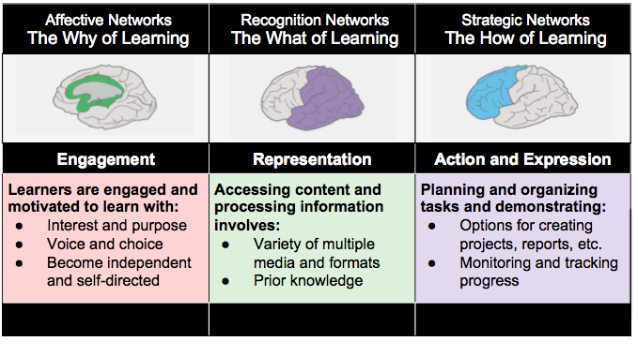
Universal Design for Learning (UDL) developed by David Rose and Ann Meyers of the Center for Assistive Special Technology (CAST) was designed to reduce the barriers to the curriculum and maximize learning. UDL provides a framework for all learners to help them become self-directed and independent expert learners. UDL has reordered the principles and guidelines, to begin with, Multiple Means of Engagement, the Why of Learning that compliments how the Design Thinking Process involves learners in identifying an authentic problem or challenge.
- Multiple Means of Engagement (Why) is the affective network that explains how interest and purpose engage and motivate learners to want to learn.
- Multiple Means of Representation (What) is the recognition network of how content is represented and how learners process information.
- Multiple Means of Action and Expression (How) is the strategic network involving how learners monitor progress and demonstrate and reflect evidence of learning.
http://www.cast.org/our-work/about-udl.html
The National Center on Universal Design for Learning goes deeper referring to the alternate version of the UDL Guidelines found in the book UDL Theory and Practice by David Rose and Ann Meyers where the order of the principles and the guidelines have changed to start with the WHY. The UDL Guidelines provide a deep dive into each of the principles to checkpoints that provide resources, examples, and research. We pulled together the phases of the Design Thinking Process and identified specific options under each principle to create a Design Thinking Process and UDL Planning Tool for teachers.
Design Thinking and UDL Planning Tool

In the initial phase of defining the problem, the teacher involves learners to generate possible authentic problems within their local community. The problem can be defined by the teacher to encourage learner interest. We connected the UDL principle Multiple Means of Engagement to this phase by providing options for recruiting learners’ interest through optimizing relevance, value, and authenticity. To understand the problem, the teacher activates learners’ background knowledge and invites them to highlight patterns and critical features around real-world problems that impact them.
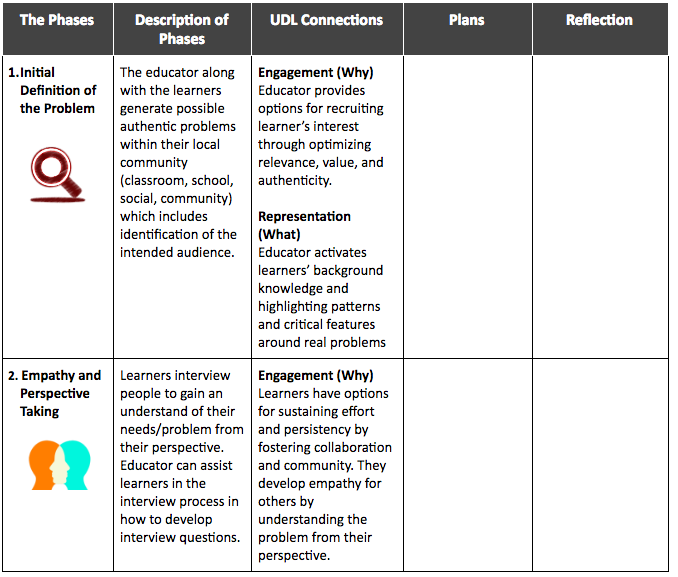
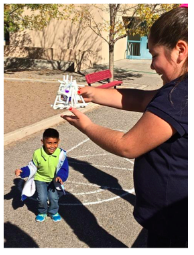 The UDL connection to Engagement to the second phase of Empathy and Perspective Taking made so much sense to us. The UDL connection involves learners having options for sustaining effort and persistence by fostering collaboration and community. This phase is where learners gain an understanding of the needs of specific people about a problem from their perspective. They may interview, do observations or survey them about the problem.
Some lessons can involve a specific problem identified by the teacher who first wants to encourage empathy. We provide one example around an Egg Drop and the Design a Squishy Circuit for a Classmates (see these examples at the end of this post).
The middle phases of the Design Thinking Process involve the iterative steps related to idea generation and prototype-test-refine as well as getting feedback from the users.
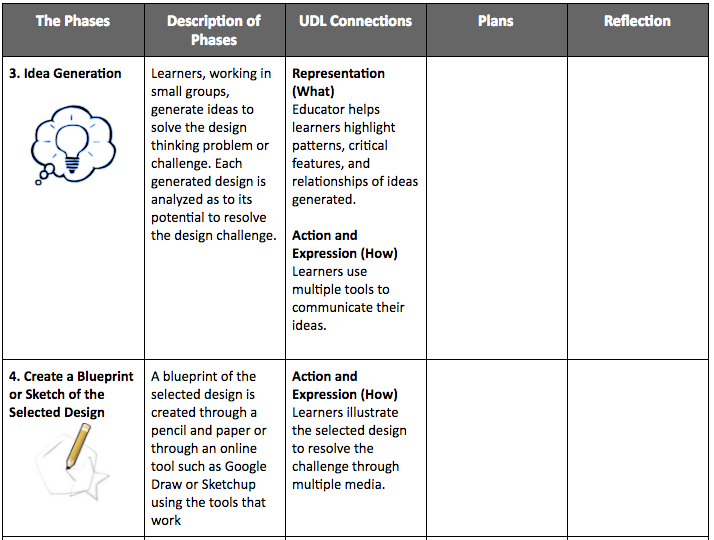
As can be seen in the UDL Connections column of the Design Thinking and UDL planning tool, representation and action and expression can be explicitly addressed. Representation or the What of Learning is a strong focus during the Idea Generation and Feedback from Users phases as the educator helps learners highlight patterns, critical features, and relationships of their discoveries. The Action and Expression or the How of Learning emerges most strongly during the Creating a Blueprint and Prototype-Test-Refine Phases as learners include their own personal touches and preferred means of expression.
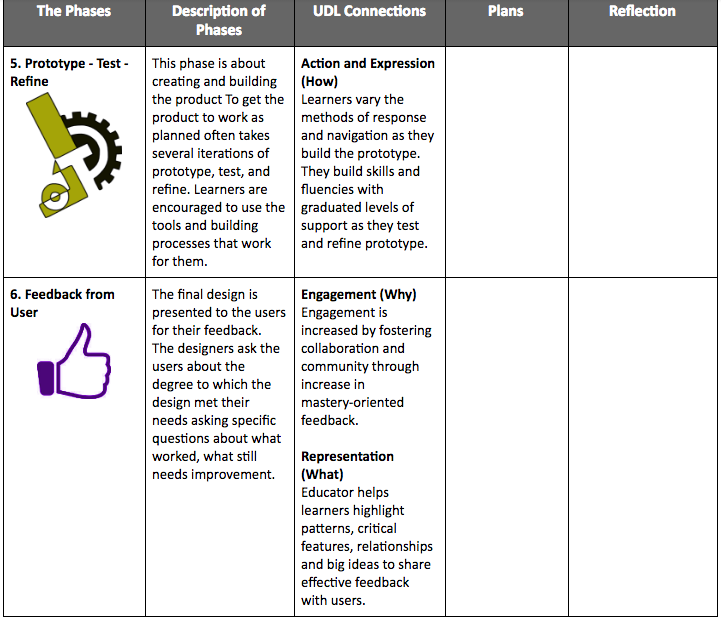
The final phases of the Design Thinking Process involve reflection on the design and making experiences and then sharing out the results to a broader audience.
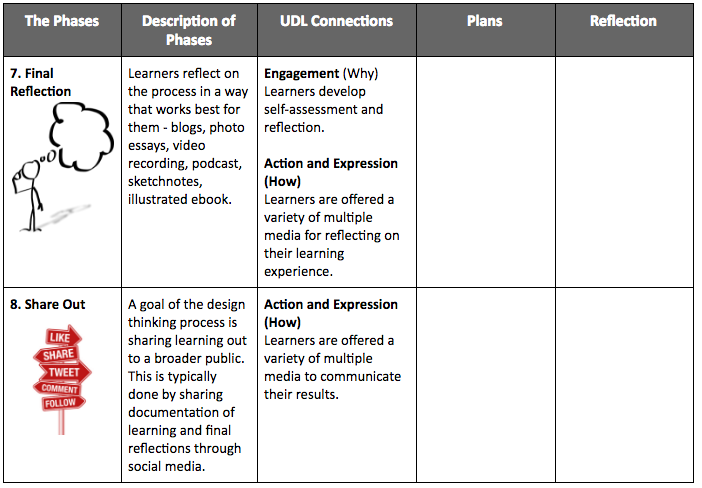
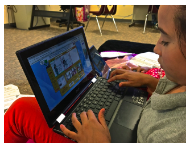 The UDL connection to Action and Expression is especially strong in the final phases of Reflection and Sharing Out. During the reflection phase, learners are given the option to express what they learned during and because of their STEM, STEAM, Maker Education experience in a way that makes the most sense to them given the nature of the task; and their preferred means of expression. This is especially relevant given all that technology and online tools provide.
For example, students can write a blog, create a photo essay with a caption, record a podcast or video, do a hand-drawn or online sketch, create a comic. Learners, many being savvy at the use of social networks, can then choose how they want to share out their reflections. This serves several purposes related to Action and Expression: (1) it gives learners an authentic audience, and (2) it helps other makers learn from their personal experiences.
Two Examples of STEM, STEAM, and Maker Education Activities using the Design Thinking and Universal Design for Learning (UDL) Planning Tool
We hope the Design Thinking and UDL planning tool we developed helps you guide the design of learning activities that focus on STEM and STEAM and brings makerspaces into your classrooms.
We welcome any comments, ideas, or questions.
****
 Dr. Jackie Gerstein’s byline is, “I don’t do teaching for a living. I live teaching as my doing . . . and technology has amplified my passion for doing so.” Dr. Gerstein has been teaching in-person and online for several decades. Currently, she teaches master’s level online courses in educational technology for Boise State, Walden, and Western Governors’ Universities as well as gifted elementary education where she focuses on STEM, STEAM, and Maker Education
She believes that one of the roles and responsibilities of the 21st-century educator is to share resources, ideas, and instructional strategies with other educators.
Jackie actively blogs at https://usergeneratededucation.wordpress.com/ and tweets at https://twitter.com/jackiegerstein
This post is also cross-posted on Jackie’s website at https://goo.gl/bnu1NB.
Additional Resources referenced from Jackie’s blog:
- Introducing Design Thinking to Elementary Learners
- Video Game Design with Elementary Learners
- Student Voice Comes With Teachers as Listeners
- Giving Students a Voice Models High-Quality Learning Processes
- Today’s Education Should Be About Giving Learners Voice and Choice.
- Show Learners The Possibilities and Get out of the Way
*****
 Barbara Bray worked with Jackie to design the Design Thinking Process and UDL Tool. This is Barbara’s blog so all the information about her is under the about tab. Barbara blogs and invites guest posts here, hosts podcasts at Conversations on Learning, and co-authored two books on personalized learning with Kathleen McClaskey: Make Learning Personal and How to Personalize Learning,
Follow Barbara on Twitter at https://twitter.com/bbray27
*****
Interested in checking out the Rethinking Learning podcasts and reflections, click on the podcast tab at the top, the logo below, or go to https://barbarabray.net/podcasts/
About the author
