

Stay Connected with Grow Your WHY
Recent Posts

Archives
Reimagine and Expand the Role of Music in Education with Patrick Cerria (EP173)


Podcast: Play in new window | Download
Subscribe: Spotify | TuneIn | RSS
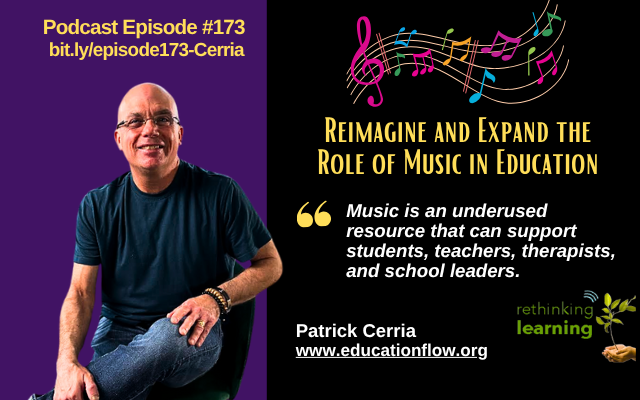
Patrick Cerria is a music educator, researcher, author, and speaker who helps teachers, administrators, and school therapists reimagine and expand the role of music in their school. As a graduate of Dalcroze Eurythmics from the Juilliard School, speaker, and author of “Finding the Flow,” Patrick is passionate about how music can support students and teachers. He teaches every imaginable student population, including students on the Autism spectrum, those classified as at-risk, those with behavioral and/or emotional classifications, physically and/or developmentally disabled, and typically developing.
Your WHY
My WHY is twofold. I love music. It is further leveraged within education to support students and teachers.
Your Background
I was born in Hoboken, New Jersey, which (if you don’t already know) is the birthplace of Frank Sinatra. I was baptized in the same font as Frank! I lived a stereotypical New Jersey life, raised by an Italian father and an Irish mother. Our house was always engulfed in music because my father listened to a very eclectic collection that included jazz, classical, Broadway cast recordings, pop, rock, opera, country, and folk music. My father also played a little guitar, and in the summer months, I would sit outside on our little patio after dinner and strum his guitar and sing folk songs.
If I’m being honest, my school experience was pretty terrible. Mind you, I was a good student academically until the fourth grade, but then I began to struggle. The catalyst of my struggles was math. I have since realized that learning math is like building a Lego set: If you miss one piece, the whole build gets messed up. That’s what happened to me and math. I missed a piece, and it messed me up until the day I barely graduated from high school. I often tell people that I was a “less than atrocious” student in school because to refer to myself merely as “atrocious” affords me too much credit. School was just a struggle for me.
I wrote my senior thesis in college on teacher training, even though I wasn’t an education major. My advisor asked me why I chose this topic. I said, “It’s just something that’s always fascinated me”. He told me it was a good topic and then said, “I want you to sum up your time in school for me in one word. Say it NOW!” Then he clapped his hands. The first word I blurted out was “Uncomfortable!” That word “Uncomfortable” sums it up.
I never felt comfortable in school. I always felt out of place.
How did you come to love music in school?
The music room was my salvation. It was the only reason I went to school. I would physically walk into the building and then do nothing all day except in the music room. I loved band, jazz band, music theory, and chorus. My band and chorus teachers in the 5th and 6th grade were two of the kindest and most patient individuals I’ve ever met. They made me feel smart. I had a massive crush on my chorus teacher, Miss Dellavale. She was French and always dressed so chic, but she was also a great teacher and had us sing different songs and pieces. In 6th grade, she told me to try out for the school play…so I did. I got one of the lead roles. It was a comedic role. When I got up on stage and heard the audience laugh, it was the first time in my life that I felt relevant.
Can you explain Dalcroze Eurythmics and your studies at the Juilliard School?
I ended up studying Eurhythmics completely by accident. After college, I was a professional touring musician for about a decade. Once, when I was home from touring, I took my young son to a parent/child music class. After we got home, I told my wife, “I think I can do classes like that, but better.”
So I created my program and curriculum called TumbleJam™ and opened a small studio in the fall of 2003. After our first year of business, it came to an end. I wanted something that would inspire me with some new ideas to help keep my classes fresh. I signed up for a three-week Eurhythmics workshop in New York City. The workshop was taught by Bob Abramson, who also taught Eurhythmics at The Juilliard School. I had just a surface knowledge of Eurhythmics going into the workshop, and ended up being blown away by all of it.
Those three weeks with Bob Abramson changed my life. A few weeks after the workshop ended, Bob Abramson called me and said, “You will be one of my students.” That’s how it started. Those three years of work with him also coincided with my working with a team of occupational, speech, and physical therapists in my studio. We ran programs for children on the Autism spectrum and other sensory-based delays, as well as programs for children with cerebral palsy.
Those three years were SO influential on the way I teach, and how I view what music is to the learning and development process.
Share about the Research on Music, Education, and the Brain
I became very interested in movement, music, and the brain through my work with the team of occupational, speech, and physical therapists. We worked with children who had cerebral palsy and had suffered what’s called a Hemiplegia of the arm, hand, or both. A hemiplegia is when functionality is lost due to a stroke suffered in utero. We even had some children who’d suffered hemiplegia of a whole side of their body. The type of therapy the team did is called constraint therapy. What they would do was have the children put their functional hand/arm in a cast, which forced them to use their hemiplegic arm/hand.
The point of the therapy was to have the brain rewire itself to bring functionality back to the hemiplegic hand. It was through this work that I learned about neuroplasticity.
Through working with these children, I (as well as the therapists) noticed that many of the kids would accomplish physical tasks with me, and music, that they would not do in their straight therapy sessions. I began to get intrigued by why this happened. A few years later, I started the next phase of my Eurhythmics studies at Carnegie Mellon University in Pittsburgh, which brought neuroscientists who were researching Eurythmics and music interventions to lecture and participate in our classes. That’s how I got to the point I’m at now.
Book: Finding the Flow
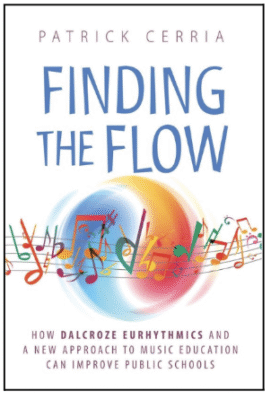 My book, “Finding The Flow: How Dalcroze Eurhythmics And A New Approach To Music Education Can Improve Public Schools,” was a featured title at the SXSW EDU conference bookstore in Austin, TX, in 2023 and 2024.
“Finding the Flow” was inspired by my studies in Eurhythmics and working with varied student populations. I had the idea of a book floating around in my mind for years, and wrote most of it in my head when I would walk my dog, Cookie, in the woods early in the morning. I would talk about the chapters and ideas out loud, so she was a good listener.
On Amazon at https://amzn.to/4kRq39t
What’s next for you?
 I am presenting my abstract for a study on Eurhythmics-based interventions in speech therapies for Autistic children at the University of Luxembourg in July 28-31, 2025, at the 7th International Conference for Dalcroze Studies (ICDS). I am teamed up with a fellow researcher, Dr. Beatrice Ilari, at the University of Southern California’s Thornton School of Music, who is brilliant. I met her at a conference a few years ago where she was one of the keynote speakers. I was presenting a small pilot study I’d done on Eurhythmics interventions and Autistic children with speech delays. She came to my presentation (I was a nervous wreck), and at the end, she asked if we could work together on a larger study. I am excited to work with Dr. Ilari and have lectured in her classes at USC. She even used my book in her graduate music education course.
My ultimate goal and vision are to help schools and music educators reimagine and expand the role of music in school.
I am not only doing my work with speech therapies and Autistic children, but have also started developing a workbook that will help students better comprehend and learn math concepts like formulas and algorithms through music. I am excited about this project because it came out of implementing these ideas directly with students in alternative education, specifically those classified as at-risk. I recently presented a workshop at the New York City Arts in Education Roundtable conference and spoke about these subjects. The response was great. Mind you, I’m very proud that I have presented staff development workshops and lectured on my ideas to music educators, arts educators, non-music educators, and college students. The response is always the same: very positive. I want to help make a difference.
Patrick Cerria’s Contact Information
 Email: patrickc@educationflow.org
Website: https://educationflow.org
LinkedIn: https://www.linkedin.com/in/patrick-cerria-38541b78/
X: @EducationFlow
*****
I hope you enjoyed my conversation with Patrick Cerria. I was fortunate to meet Patrick three years ago at SXSW EDU and became friends. I followed Patrick’s journey with music education, and when he launched his book. His book, “Finding the Flow,” was on the same table at the bookstore near my book for the last two years at SXSW EDU. I’m so grateful we had this time together on my virtual porch. It was a casual conversation that developed into wonderful stories. Please share this post and podcast with your friends and make sure you connect with Patrick..
*****
About the author
