

Stay Connected with Grow Your WHY
Recent Posts

Archives
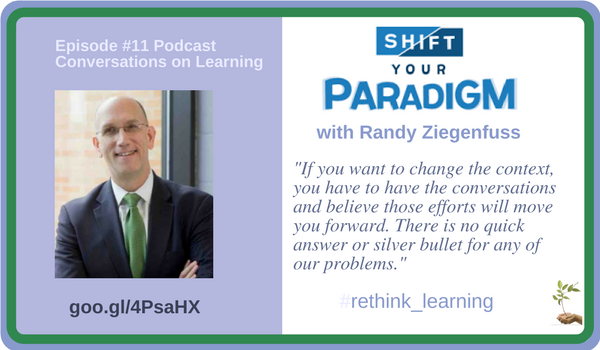
Episode #11: Shift Your Paradigm with Randy Ziegenfuss


Randy Ziegenfuss, Ed.D. is Superintendent at Salisbury Township School District and Clinical Adjunct Professor at Moravian College in Pennsylvania. Randy is a blogger, speaker, and podcast host at TLTalk Radio and Shift Your Paradigm.
Podcast: Play in new window | Download
Subscribe: Spotify | TuneIn | RSS
I have known Randy for several years on social media and have been fortunate to be on his podcast show twice. When I met him in person at Educon last January, we had a great talk about the future of learning. I knew then he was going to keep pushing the edge with his co-host Lynn Fuini-Hetten, especially now with their new show, Shift the Paradigm. I was so excited that Randy agreed to join me on my podcast and below are excerpts from our conversation on learning.
Can you share about you, your background, and your journey as superintendent of Salisbury Township School District?
 Yes, I am currently Superintendent of Salisbury Township School District in Pennsylvania. It was fun meeting you at Educon in Philadelphia last year. In fact, we’re located about an hour north of Philadelphia and 90 minutes to New York city. It’s a great place geographically being so close to cultural events. This is my 32nd year in education. My first 12 years I taught middle school music, general music, and musical theater. I was a music major in college. About 8 or 9 years into my teaching, this thing called a computer landed in my classroom. I got very curious about what I could do using computers for kids learning music. We were sequencing music and making all sorts of sounds. If you walked by my room, it was like a three-ring circus. Kids were doing all sorts of things connected to their interests and passions around music. During that time, I became interested in not only musical things but learning about technology.
After 19 years in the school district next door, I moved to a more formal leadership position as the Director of Technology here at Salisbury Township and did that for six years. I have the pleasure of working with an amazing team of teachers, students, and parents. We accomplished a lot of things during that time. Back around 2006, there was one desktop PC for each instructional area. It was a pretty traditional school. Now we are a K-12 school district where every student has their own learning device which took a lot of planning, thinking, collaborating, and work to get there. One thing I shared with Lynn Fuinehetten, my podcast collaborator and assistant superintendent here is that it has been an interesting journey to see how the conversations and the transformation really moved away from the technology to really focus on learning. Learning has changed and can change as a result of having access.
Mission: Salisbury…Inspire, Think, Learn, Grow… Together!
Can you share how you and your administration created a culture of learning?
All that I learned about leadership, I can trace back to the roots of being a musician. The way that musicians learn mirrors the way we believe powerful learning happens. As a music teacher, much of what I did involve leading groups which helped me shape what I believe is leadership. One of the things we embrace around here is that everyone is a learner and everyone is a leader. That culture of learning is exemplified in the profile of a graduate. We had a lot of conversations on what learning looks like. A few years ago we embarked on this process where we asked two basic questions to help shape our culture of learning:
What knowledge, skills, and dispositions do our current learners need to have to be successful once they leave us? We call that life; not just focusing on a career, not just making money, not just being a good citizen, but just living a good life.
What kinds of learning environments are going to help us to help them best get there? What do we believe about learning not only for our children but across the organization? If we are all learners and all leaders, then all those things we believe about learning apply to all of us.
Are these the questions you used to develop a progressive vision for teaching and learning in 2020, the Profile of a Graduate and Learning Beliefs?
It’s been good to have those two questions and the work around the profile of the graduate and learning beliefs really ground what we do around here. The profile of the graduate is essentially our vision and our job is to provide the resources and support to help you get there. We want to empower our leaders and teachers to ask those questions and think deeply about those questions because they are not questions that are easily answered. Lynn and I met with our stakeholders on their turf. The stakeholders were our students, parents, teachers, leaders, and our community and asked them those questions. We then synthesized those in the profile of our graduate and the learning beliefs to help us get there. We had to create some action plans around a culture that model those learning beliefs and that empowers our teachers, our leaders, and our students to learn in a way we say powerful learning happens.
We created professional development opportunities that really allowed our principals and teacher leadership teams to personalize their own learning journeys throughout the year that was tied to the profile of the graduate goals. What was really exciting and kind of frightening was we found that every school was not doing the same thing in the same way at the same time. Each principal and leadership team had the opportunity to identify the needs, the gaps, how to harness the strengths of the people within their school, and how to create something new to move them toward the goals. Each school is different and the work models our emphasis on personalization. Hope this gives you from a leadership perspective a background of Salisbury as a learning culture.
Are these the questions you used to develop a progressive vision for teaching and learning in 2020, the Profile of a Graduate and Learning Beliefs?
It’s been good to have those two questions and the work around the profile of the graduate and learning beliefs really ground what we do around here. The profile of the graduate is essentially our vision and our job is to provide the resources and support to help you get there. We want to empower our leaders and teachers to ask those questions and think deeply about those questions because they are not questions that are easily answered. Lynn and I met with our stakeholders on their turf. The stakeholders were our students, parents, teachers, leaders, and our community and asked them those questions. We then synthesized those in the profile of our graduate and the learning beliefs to help us get there. We had to create some action plans around a culture that model those learning beliefs and that empowers our teachers, our leaders, and our students to learn in a way we say powerful learning happens.
We created professional development opportunities that really allowed our principals and teacher leadership teams to personalize their own learning journey throughout the year that was tied to the profile of the graduate goals. What was really exciting and kind of frightening was we found that every school was not doing the same thing in the same way at the same time. Each principal and leadership team had the opportunity to identify the needs, the gaps, how to harness the strengths of the people within their school, and how to create something new to move them toward the goals. Each school is different and the work models our emphasis on personalization. Hope this gives you from a leadership perspective a background of Salisbury as a learning culture.
Can you share the background of TLTalkRadio with Lynn Fuinehetten? with Working at the Edge?
 Lynn and I wanted to model this idea of being learners. There was professional development focusing on pockets of innovation that was happening in districts. Mostly our conversations were with teachers who did project-based learning, personalized learning, genius hour, digital portfolios, etc. We decided to find educators and authors who were mostly curious and open to change like you and Kathleen. Lynn and I modeled the learning process by reaching out to you and others, reading your books, and having conversations with you. We hope to take an hour of your time and get inside your brain, understand your expertise and bring that back to our community. The podcasts, especially with authors, have been informing our practice.
One person we interviewed was Education Reimagined’s Director, Kelly Young and that’s where we were exposed to the idea of the North Star that they have in their white paper. We dug into the lexicon around words and these ideas of not defining terms but defining the parameters. Then letting educators inside those parameters like a sandbox. How do they create their own understanding and possibilities out of setting those parameters? We became very interested this strategy in involving all of our stakeholders to adapt and tweak the five learning beliefs with some more refined statements, parameters, and boundaries. We wanted everyone to be involved in the design from a learner’s perspective instead of top-down decisions.
Now you are sharing your learning and thinking on the Shift Your Paradigm Project. Can you tell me about the conversations and how you and Lynn make connections to practice?
 As we were having these conversations around the five elements of the North Star, we inquired about this idea of leadership. If we are to create these learning environments, what kind of leadership does that require? Reflecting on our own practice, Lynn and I came to the realization that we do have to behave differently as leaders with different mindsets and potentially different skills. Shift Your Paradigm is designed to connect with leaders and learners from around the country who have created and are working on creating these kinds of learning environments. We try to get inside their heads to understand the ways in which they lead these kinds of learning cultures. That’s been a fascinating project and it’s really only begun with about nine episodes now. We expect this to be a pretty extended project, but ultimately, Lynn and I in the end really want to contribute something new to the conversation around re-imagining leadership through the learner-centered paradigm.
If shifting the paradigm doesn’t make sense, I suggest linking to the work at Reimagined Education. What’s so freeing about it is when you shift your paradigm to the idea of learner-centered, you begin to look at everything that happens within our culture that way. That’s what got us to look at leadership because this is so different. The dominant conversation is school-centered, top-down control that does not include learner agency. Now learner agency is at the core of everything that we do. As leaders, it also needs to be at the core of what we do too. How do we create opportunities for others to experience that learner agency? When you shift your thinking from the top-down control even though there may be times for that in our highly regulated domains of education, there are more times than not when we can truly be learner-centered throughout the whole system. We’re sort of beginning to uncover how we can do this differently not only in the classroom but across the whole organization. We’re a small school district with 1600 students. The shift in paradigm is about having conversations and building relationships and it is easier when you can get to know everyone. http://workingattheedge.org/shift-your-paradigm/
I’d like to expand on the idea of building relationships. What do you think of taking the first two weeks to build culture before jumping into academics?
One of the things we need to know about building relationships is that it takes time. I know so many school leaders that jump into quick solutions. You have to not be distracted by that. You have to be willing to put in the time to have conversations with people because it is a shifting of a mindset. In order to do that you have to build a relationship with that person or a group of people. Everybody needs to understand the intent and the way that you are approaching things. If you don’t put that time in, that’s when you might get something but it will not stick around or last. It hasn’t grown those roots or given it that time needed to take hold. I think that’s one of the things that is a little upsetting for our education community in general. There are a lot of ideas that are perceived as the silver bullet or the quick solution. Just read this book or follow this formula and then you will make it or it will happen and your life will be better. They can be great resources to start the conversations to get the thinking going. Every context is different. If you want to change the context, you have to have the conversations and believe those efforts will move you forward. There is no quick answer or silver bullet for any of our problems. If there was, then we wouldn’t be here wanting to shift the paradigm. That’s one of the things I struggle with. As a leader, how do we hold that “stuff” at arm’s length and say maybe there’s a value in that but let’s be very critical about what is that value. We need to allow the space and the time for people to figure that out.
It’s not just me doing this. My colleague Lynn does a fabulous job building relationships with people and encouraging conversations. I just happen to be the superintendent. It takes a whole community with everyone involved including our amazing kids. This year we are going to schedule conversations with kids so you can hear their voices and more on social media. My district’s Twitter handle is @yoursalisbury
Connect with Randy on Twitter, the TLTalkRadio podcast, and the Shift Your Paradigm podcast!

Randy Ziegenfuss, Ed.D. is Superintendent at Salisbury Township School District and Clinical Adjunct Professor at Moravian College in Pennsylvania. Randy is a blogger, speaker, and podcast host at TLTalk Radio and Shift the Paradigm.
Randy is a life-long educator with 30 years of experience developing a passion for teaching, learning, leadership, technology and supporting the life-long learning of all students and staff. Strong background in developing and leading the implementation of a progressive vision for education, balancing increased opportunities for students with fiscal responsibility. Highly motivated by organizational challenges that involve new learning and problem-solving. Skilled at working collaboratively with a variety of stakeholders in the organization on small and large-scale projects, utilizing a data-informed stance to identify needs and take action to achieve goals. Accomplished educational professional with refined interpersonal and communications skills.
Twitter: @ziegeran
LinkedIn: rziegenfuss
Email: ziegeran@gmail.com
Website: http://www.workingattheedge.org
Podcast Shows: @TLTalkradio and @ShiftParadigmPC
Weekly Podcast: Future Learning
Lynn Fuini-Hetten (@lfuinihetten)
District Twitter: #YourSalisbury
Latest Publications
- The eBook 3 Key Principles of Digital Transformation.
- The K12 Leader – January 2017 – Edleadership Blindspot: A Compelling Vision for Learning
- Edutopia – May 2016 – Innovate Salisbury: An Action Research Project (Co-author)
*****
Interested in checking out more of the Rethinking Learning podcasts and reflections, click on the podcast tab at the top, the logo below, or go to https://barbarabray.net/podcasts/
About the author
