

Stay Connected with Grow Your WHY
Recent Posts
Archives
UDL and the Why of Learning


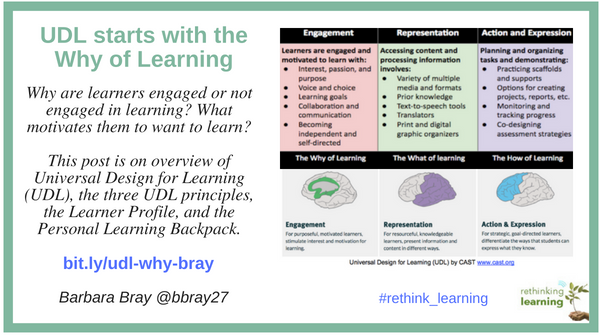
Universal Design for Learning (UDL) was developed by David Rose and Anne Meyer from CAST (Center for Applied Special Technology). After learning more about UDL, I can see how UDL can be the framework for learning for all learners of all ages.
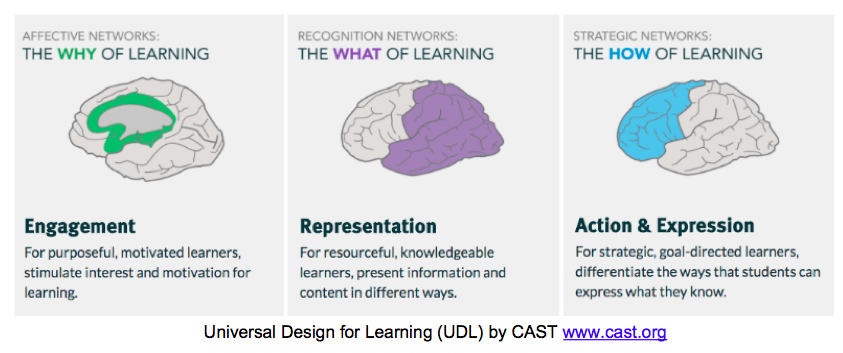
The three UDL principles:
- Multiple Means of Engagement = The WHY of Learning
- Multiple Means of Representation = The WHAT of Learning
- Multiple Means of Action and Expression – The HOW of Learning
I love that UDL starts with the why and how learners are engaged and motivated to learn. The WHY means what learners are interested in and passionate about. I like the idea of being curious about who we are as learners. Why not ask our own WHY to ourselves about how we learn?
Why are we engaged or not engaged in learning?
Why do we need to be motivated to want to learn?
Why would we want to become independent and self-directed?
UDL Principles
I decided to explore the UDL principles from my perspective as a learner. I know that I need to be motivated first about something new that I want or need to learn. I’m kind of busy. There has to be a reason or purpose for my learning. When I thought about this, I got it why UDL starts with Multiple Means of Engagement. This is what makes learning personal for me. It is not about what someone else teaches me unless I choose to take their course. I first have to be interested in what I want to learn. So I decided to add a few strategies for each of the three UDL principles to help me understand what that might mean for all learners.
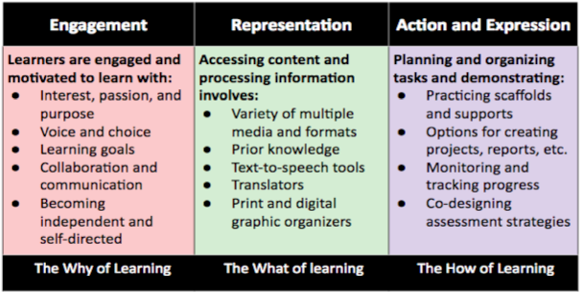
The bullet points I listed may vary depending on who applies these concepts of the why, what, and how. In my first book, Make Learning Personal, UDL started with the What of Learning. Recently, Anne Meyer, David Rose, and David Gordon, co-authors of Universal Design for Learning: Theory and Practice, changed the order of the principles to start with the why. I agree with them. I really believe you need to know the why before the what and how.
Learner Profile
When I put the ideas together this way, it made sense for me. I could see why it is important to start with the WHY of learning. We need a voice and choice in our learning so we have a say in how content is represented. We may all process that information differently so this is why we need to know how we learn best. UDL helps us do that. I figured if I’m going to share this, I needed to see how it worked for me as a learner. So I took the approach I used in the work I did with personalizing learning but changed it to fit the idea of starting with Multiple Means of Engagement and the Why of Learning.
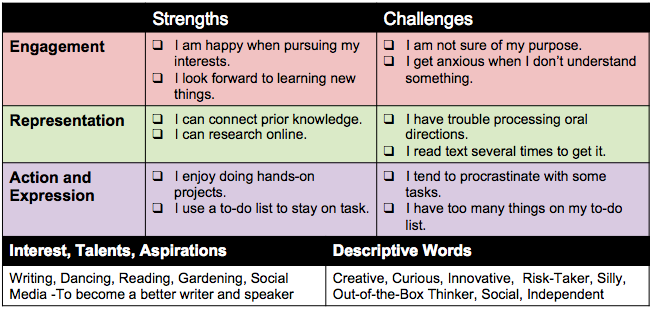
When I consider the principle of engagement, it is more than just engaging me in learning; it is how I am empowered to want to learn. I have a more detailed survey that I use with schools I work with, but I found that sometimes less is more. I also had to show that engagement was about motivation and purpose and different than what was listed under action and expression. I just put in a few bullet points under each section, but you can add as many that apply to you.
Why would learners want to focus on interests?
How can learners be empowered to learn?
How does having a purpose affects motivation?
Preferences and Needs
What I noticed is that when I started writing about my strengths and challenges for engagement, it was all about purpose. I wasn’t sure of my purpose. This was big for me. I’ve been focusing on making learning personal for years and now I wasn’t sure. It’s not about making learning personal for someone else. Each learner needs to find that out for themselves.
When I added information for me, I saw me. I wanted to share it. I shared this idea with some educators and asked them how they would use this. So they filled it out and then shared what they found out about themselves with peers. I’m going big by sharing mine with you. When I asked someone what they thought about what I wrote, they asked me questions that led to some very interesting conversations. One teacher said that when I wrote I wasn’t sure of my purpose, it helped her feel okay about being vulnerable in front of others. She thought I knew everything. No one knows everything. I definitely do not feel like an expert. Every day I learn something new and am humbled by how much I don’t know. The next step was to write what I preferred or needed to help me learn.
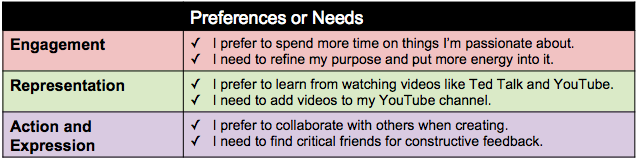
I only put a few ideas so you could get an idea of how this process works. Putting my thoughts in writing helped me see just what I was thinking. I needed to refine my purpose and spend more time on things I’m passionate about. That’s number one. That’s my WHY.
What do you prefer or need to learn?
Personal Learning Backpack
So I decided to go one step further by creating my own personal learning backpack, but I needed to change it by adding the skills, competencies, tools, apps, and resources I will need to succeed and become future-ready. I’m using that term for me and any learner because I believe learning is about preparing for whatever is ahead for us. I love technology and have always experimented with tools and apps. I find that there are so many apps that I reach out to others in my PLN for help or ideas on how to use different apps. It doesn’t matter how young or old we are, each day is new. The backpack also includes learning strategies so we own and drive our learning. This means we become self-directed and independent learners who have agency.
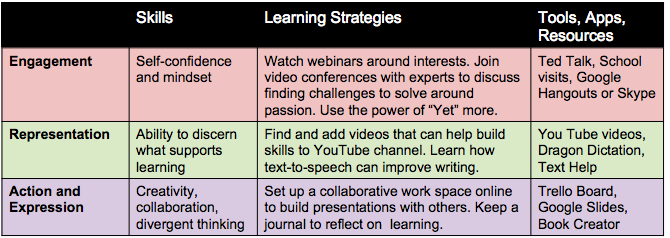
What I found out was the first thing I needed was to build my self-confidence around finding my purpose. That meant changing my mindset and using the power of YET more. I can do anything I put my mind to if I want to. I am not sure even what tools I will need to learn, YET. If I say I don’t think I can write another book, I need to add YET. If I say, I’m not sure how to do this or that, I need to add YET. I wonder what my backpack will look like in a year.
I tried this process in several workshops and keynotes. So far, the feedback was great and helpful. As I said, I am still learning so I may even make some changes. I am curious to see the backpacks learners create and the conversations they have about their learning.
Who knows what the future will hold for us?
How will you become future-ready?
What will you need to have agency?
Resources:
- CAST (Center for Accessible Special Technology) www.cast.org
- UDL Center: http://www.udlcenter.org/
- Universal Design for Learning: Theory and Practice by Anne Meyer, David H. Rose, and David Gordon: udltheorypractice.cast.org
*****
Interested in checking out more of the Rethinking Learning podcasts and reflections, click on the podcast tab at the top, the logo below, or go to https://barbarabray.net/podcasts/
About the author
