

Stay Connected with Grow Your WHY
Recent Posts


Archives
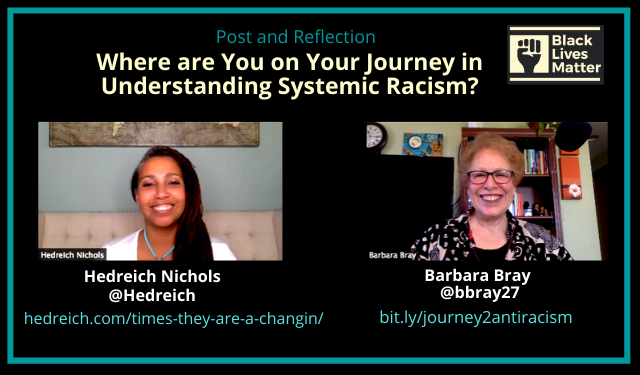
Where are you on your journey in understanding systemic racism? with Hedreich & Barbara (Reflection #6)


Podcast: Play in new window | Download
Sometimes, a conversation is way more than a conversation. Several of those conversations I had with Hedreich Nichols empowered us to explore the different needs that black and white educators have when discussing how to create more equitable schools and communities. We talked about what systemic racism means for different people and how the problem can be approached from varying perspectives. We started writing this document together in a Google doc and want you to know that this is a “work-in-progress.” We will be updating it with a reflection and feedback from you. Here is the PDF version of this post (6/18/20).
The pandemic and tragic deaths of George Floyd, Rashard Brooks, Ahmaud Arbery, Breonna Taylor and so many other black lives have exposed the inequities that have always been there. Now, along with exposing more police violence against people of color, current racist policies, and the long history of racial injustice, we cannot be silent anymore. Silence means being complicit. The protests are worldwide and people of all segments of society are coming together to demand that we act systemically to end hate, racism, violent police actions, and senseless murders.
Identifying where you are on the journey to understand systemic racism and discrimination depends on your own racial identity, the environment you grew up in, and the environment in which you now live and interact.
Racial Identity Models
The White Racial Identity Model (Helms) lists 6 stages in this document on Racial Equity Tools is a Compilation of Racial Identity Models:
| 1. Contact | taking a non-racist position and do not understand the position of their own privilege |
| 2. Disintegration | feeling guilt and shame and wanting to channel those feelings in a positive way |
| 3. Reintegration | believing that they may deserve their white privilege and are superior |
| 4. Pseudo-Independence | expecting people of color to confront and uncover racism for them |
| 5. Immersion/Emersion | attempting to connect to their own white identity and to be anti-racist |
| 6. Autonomy | has a positive connection to their white racial identity while pursuing social justice |
Depending on which self-identified stage white people find themselves in, they may respond differently in uncomfortable situations. People at any stage may benefit from support to build confidence in responding to students, colleagues, family, and friends when talking about racism and discrimination. The main thing is that we are all learning. We may say or do something wrong. It took a long time to get to this point so it will take some time to get things right. We will make mistakes and be uncomfortable along the way so we hope you have grace and are kind to each other during your journey.
Four Situations to Consider
We thought we’d start with four situations teachers or anyone might be in when feeling uncomfortable or not sure what to say or do when discussing racism.
- Unaware or no interaction
- Living or teaching in a diverse setting
- Understanding inequities
- Champion for equity
Unaware or no interaction
What if I grew up and live in a place with very few people of color and had little interaction with those who don’t look like me?
Check out these resources:
|
| Scenarios | Try this… | Not this… |
| I saw this thing on social media about finding a black mentor. | Consider Googling “How to become more culturally responsive”. Check out the resources above. Expand your circle if all your friends look like you. | Saying that you’re “colorblind” and expect someone else to do the work you can do yourself. |
| I am mandated to learn about racism in my job. | You can be the change that gives children a better future. Start with one book and one video to begin your journey. Check the list above. | Doing the same things or teaching the same curriculum the same way and not implementing changes that highlight histories, philosophies, and accomplishments of various cultures. |
| I don’t have any black people in my life. I believe racism is caused by talking about it. | Hate can spread and impact your community. It can start with your children who go online or talk to their peers and can learn hateful speech. Do your own research so you can talk about racism from an informed point of view. | Thinking that your voice does not matter or thinking that keeping silent isn’t complicity. |
Teaching or living in a diverse setting
What if I have had little interaction with people of color and now live or even teach in a diverse setting?
Check out these resources:
|
|
| Scenarios | Try this… | Not this… |
| There are no people in my neighborhood or teachers of color in my school. | Check out the resources above and have conversations with your neighbors or with teachers in your school. | Thinking that you cannot do the work without a person of color guiding you. |
| I have not addressed the topic of racism with my neighbors, my students, or teachers in or outside of my school. | Ask questions? Make it a family project. Encourage your students and colleagues to ask questions and do research with you. | Keeping silent. |
Understanding inequities
What if I get it that people of color have been discriminated against and adversely impacted by systemic inequities?
Check out these resources:
|
|
| Scenarios | Try this… | Not this… |
| I’m not sure what I can do about system racism during this pandemic. | First, modeling being safe if you protest by wearing a mask and physical distancing the best you can. | Protesting without a mask or without maintaining safe physical distancing. Assuming people you know are registered to vote. |
| I’m feeling guilt and shame about being white for all the injustices that happened. | Working locally or remotely to get people out to vote. Fighting voter suppression. Finding and joining organizations that are making an impact. Get others involved. | Feeling guilty and not doing anything. |
| I was just made aware or have know about the policies and police actions against people of color and not sure what I can do about them. | Watching and discussing 13th with colleagues about the systemic incarceration of people of color. Voicing your concerns about for-profit prisons at city council meetings and contacting elected officials changing policies.Using safe intervention strategies to stop injustices when you see them happening. | Sitting on the sidelines talking about it but not doing anything to make change happen. |
Champion for Equity
What if I have long been a champion for equity and sometimes have a difficult time interacting with people who are “only just now” realizing that there is a problem?
Check out these resources:
|
|
| Scenarios | Try this… | Not this… |
| I work with someone who is in the reintegration stage; that they feel they deserve their white privilege and are superior to people of color. | Be okay about standing up for people of color and the injustices that keep happening. | Not taking any action when someone says or does something racist. |
| In our staff meetings, one colleague mentioned being afraid to talk about racism. | Reach out to those colleagues to be a mentor or support them on their journey. Read together. Offer to lead a book study with your staff or encourage conversations about racism on a regular basis. | Not reaching out and continuing to do the work alone. |
| I am a white woman who is not sure what to say or not to say about racism. | Say “I see you” or “that’s awful” as an expression of connection so it is not about you. Read this article 5 racist -anti-racism things good white women give to viral posts for more ideas. | Saying “I’m so ashamed” is about you. Saying it is not “all white women” is saying that it is okay for some white women to be racist. |
For more information about understanding systemic racism, check out this document scaffolding anti-racism resources that provide extensive resources, questions to ask yourself, people and organizations to follow, and so much more.
Hashtags to use to learn more about racism, discrimination, and police violence: #BLM #BlackLivesMatter #ClearTheAir #educolor #8cantwait #ihollaback and of course, follow @tolerance_org
******
Hedreich Nichols @hedreich https://hedreich.com/
Check out #SmallBites on Friday nights 8p CT for ideas from Hedreich on YouTube at https://youtu.be/laRVsME-KvQ
Barbara Bray, @bbray27 https://barbarabray.net/
Check out the Rethinking Learning podcast at https://barbarabray.net/podcasts/ and the #rethink_learning Twitter chat every other Monday at 4p PT
******
About the author
