

Stay Connected with Grow Your WHY
Recent Posts
Archives
The Teaching and Learning Continuum Moving to Learner Agency


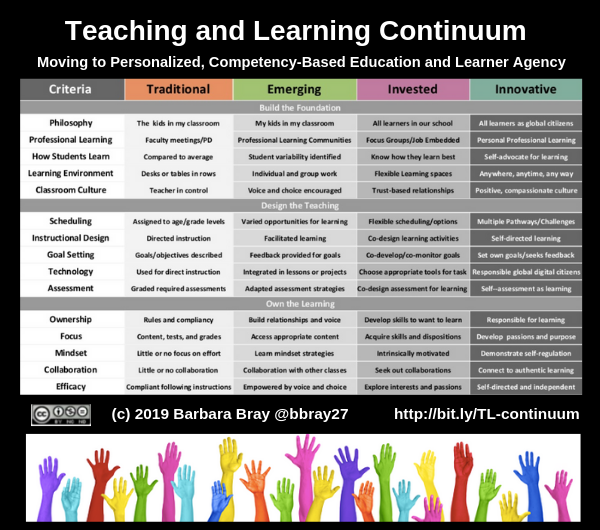
The Teaching and Learning Continuum was designed to support changing teaching practice. Teachers may not have the tools, resources, and support to change teaching practice on their own. The main challenge for teachers is time.
Schools are looking at strategies to empower teachers to take control of their personal professional learning. That is tough for some especially if the system doesn’t support them. The Stages of Personalized Learning did not address some of the concerns teachers were telling me. Schools reached out to me asking about the contents and why we didn’t include traditional models. They also felt specific criteria were missing. When I started working with Rose Colby on personalized, competency-based education, I realized how much I didn’t know. I interviewed Rose in Episode #43, read her book, and have presented with her twice at iNACOL. It’s not just about personalizing learning. It’s about changing the system to address competencies, skills, and dispositions. I got it that there is still so much more to do.
CCSSO (Council of Chief State SchoolOfficers) along with QED Foundation’s Transformational Model created a CSSR Best Practice Continua in 2012 that I saw when it was in the draft mode. I saw the potential within that document as a starting point and worked with several schools who were looking for classroom observation forms, coaching tools, ways to identify and monitor progress, etc. So in working with different ideas and models, I co-developed different tools including several ideas similar to this chart. When I shared several iterations with teachers in focus groups, we came up with different criteria and approaches across the continuum. This chart is a general overview with criteria for support moving to a personalized, competency-based system and learner agency.
My focus has been on supporting teachers as a coach for almost 30 years. I see how difficult it is for teachers in traditional systems to be innovative. Yet, the teachers I’ve met and know are amazing. They are my heroes. They do the day-to-day work to make a difference in children’s lives. They have demonstrated to me how they can take an existing lesson and look at areas where they can bring in voice, choice, and autonomy so students start developing learner agency. However, I get questions and see requests on social media for ideas, tools, resources, and other strategies to support teachers and systems. It really is more than just changing one lesson but sometimes starting small opens doors to magical learning.
You can download the chart from the link above in SlideShare and use it. Please let me know how it is working for you in the comments below, contact me here or with my email barbara.bray@gmail.com
About the author
