

Stay Connected with Grow Your WHY
Recent Posts
Archives
Bloom’s Taxonomy and Depth of Knowledge (DOK)


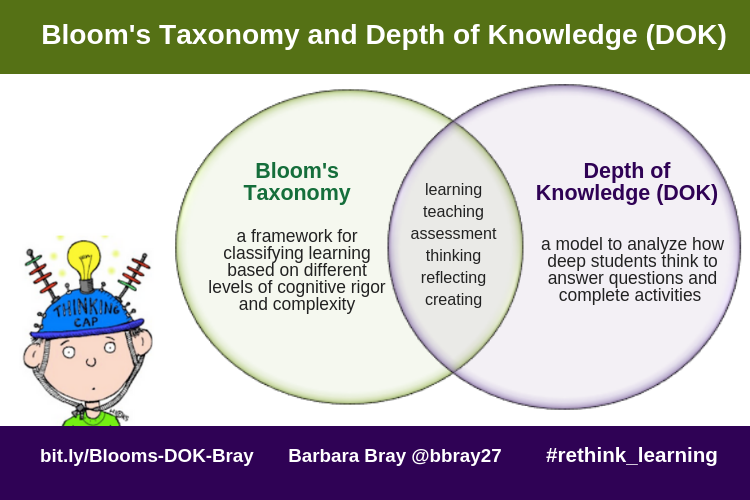
Bloom’s Taxonomy was developed by Benjamin Bloom in 1956 and revised by Anderson and Krathwohl in 2001 as a framework for classifying learning based on different levels of cognitive rigor and complexity.
The Depth of Knowledge (DOK) was developed in 1997 by Norman Webb, a research scientist from the Wisconsin Center for Education Research, to analyze how deep students think to answer questions and complete activities.
Do we use Bloom’s Taxonomy or DOK with our students or can both work together?
Bloom’s Taxonomy
Bloom’s Taxonomy is about classifying learning at different levels. Teachers can use these levels to write learning objectives and tasks to meet those objectives. The revised Bloom’s by Anderson and Krathwohl’s Taxonomy in 2001 focuses on the verbs to classify the levels of thinking and various levels of the taxonomy. Both versions classify the levels focusing on the verbs.
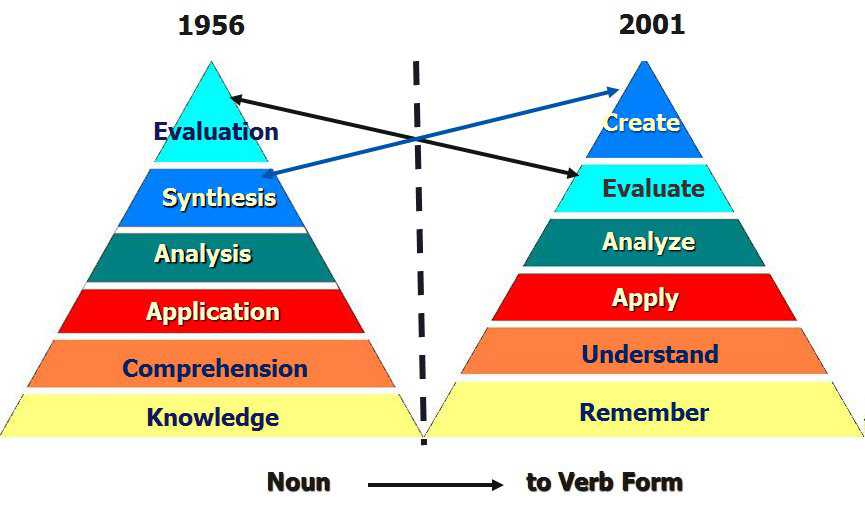
Taxonomies of the Cognitive Domain
| Bloom’s Taxonomy 1956 | Anderson & Krathwohl’s Taxonomy 2001 |
| 1. Knowledge: Remembering or retrieving previously learned material with example verbs. know, identify, relate, list, define, recall, memorize, repeat, record, name, recognize, acquire |
1. Remember Recognizing or recalling knowledge from memory. Remembering is when memory is used to produce or retrieve definitions, facts, or lists, or to recite previously learned information. |
| 2. Comprehension: The ability to grasp or construct meaning from the material with example verbs. restate, locate, report, recognize, explain, express, discuss, describe, review, infer, illustrate, interpret, draw, represent, differentiate, conclude |
2. Understand Construct meaning from different types of functions either as written or graphic messages or activities like interpreting, exemplifying, classifying, summarizing, inferring, comparing, or explaining. |
| 3. Application: The ability to use learned material, or to implement the material in new and concrete situations with example verbs. apply, relate, develop, translate, use, operate, organize, employ, restructure, interpret, demonstrate, practice, calculate, show, exhibit, dramatize |
3. Apply Carry out or use a procedure through executing, or implementing. Apply relates to or refers to situations where learned material is used through products like models, presentations, interviews, or simulations. |
| 4. Analysis: The ability to break down or distinguish the parts of material into its components so that its organizational structure may be better understood with example verbs. analyze, compare, probe, inquire, examine, contrast, categorize, contrast, investigate, detect, survey, classify, deduce, experiment, scrutinize, discover, inspect, dissect, discriminate, separate |
4. Analyze Break materials or concepts into parts to determine how the parts relate to one another or how they interrelate, or how the parts relate to an overall structure or purpose. When learners analyze, they can illustrate a mental function by creating spreadsheets, surveys, charts, or diagrams, or graphic representations. |
| 5. Synthesis: The ability to put parts together to form a coherent or unique new whole with example verbs. compose, produce, design, assemble, create, prepare, predict, modify, tell, plan, invent, formulate, collect, set up, generalize, document, combine, relate, propose, develop, arrange, construct, organize, originate, derive, write, propose |
5. Evaluate Evaluate is about making judgments based on criteria and standards through checking and critiquing to demonstrate the processes of evaluation. The revised taxonomy puts evaluate before create to be a necessary action before one creates anything. |
| 6. Evaluation: The ability to judge, check, and even critique the value of material for a given purpose with example verbs. judge, assess, compare, evaluate, conclude, measure, deduce, argue, decide, choose, rate, select, estimate, validate, consider, appraise, value, criticize, infer |
6. Create Create is about reorganizing elements into a new pattern or structure through generating, planning, or producing. Create requires users to put parts together in a new way, or synthesize parts into something new and different creating a new form or product. |
Bloom vs. Anderson/Krathwohl [source: The Second Principle]
Webb’s Depth of Knowledge (DOK)
DOK is the degree of depth or complexity of knowledge standards and assessments require; this criterion is met if the assessment is as demanding cognitively as the standards of the expectations are set for students. DOK refers to the complexity of thinking skills that a task requires.
DOK is about…
- what FOLLOWS the verb. What comes after the verb is more important than the verb itself.
- the complexity of mental processing that must occur to complete a task.
DOK is NOT about…
- verbs. The verbs are a valuable guide, but they can sometimes be used at more than one level.
- the difficulty of what they are learning. All levels of DOK have a place in a rigorous curriculum.
Completely aligned standards and assessments require an assessment system designed to measure in some way the full range of cognitive complexity within each specified content standard. Norman Webb identified four levels for assessing the DOK of content standards and assessment items.
- Level 1: Recall
- Level 2: Skill or Concept
- Level 3: Strategic Thinking
- Level 4: Extended Thinking
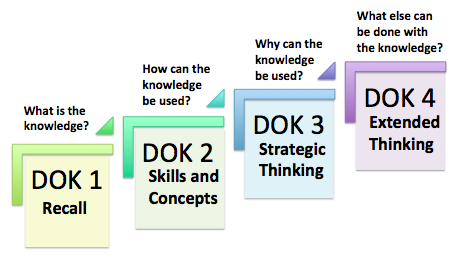
Image source: Francis, Erik. ASCD book Now That’s a Good Question!
http://www.tinyurl.com/nowthatsagq
DOK implies the interaction of how deeply a student needs to understand the content with different ways of responding and interacting with the content. [Chart source]
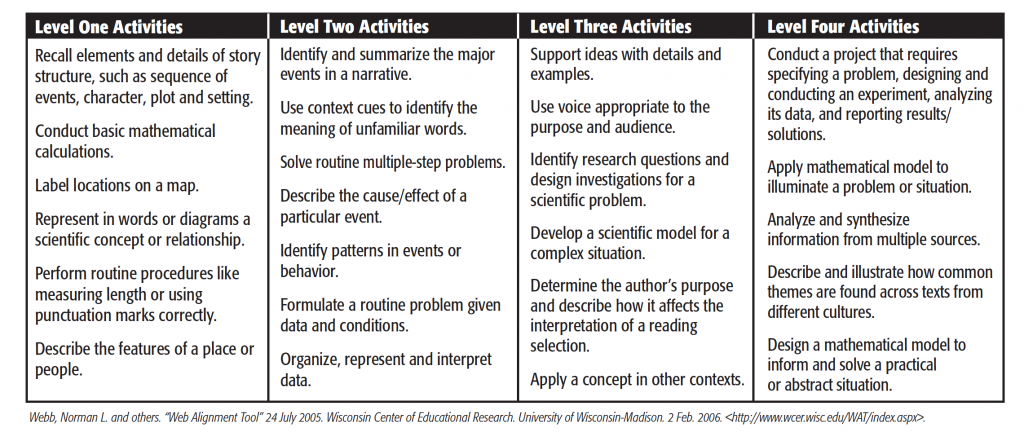
DOK levels are not related to the score points. DOK levels are a ceiling, not a target. Why is this distinction between “ceiling” and “target” important?
If assessed only at the “target,” all learners with a Level 3 as their highest demand would only be assessed at Level 3. This would potentially have two negative impacts on the assessment:
- The assessment as a whole could be too difficult; and
- important information about student learning along the achievement continuum would be lost.
- The level of a DOK item is determined by the task (defined by complex thinking and reasoning skills), not grade level or the ability of the student.
- Therefore, the DOK of the task does not change with the grade or ability of the student.
- Verbs alone do not determine the DOK’s level of an assessment task. DOK’s focus is on how deeply students need to know the content for a given response.
- Multiple-choice questions can be written at a DOK 3 or 4 level; however, to design a question in this format is difficult. An Item at DOK level 3 or 4 requires complex reasoning, strategic and extended thinking about the concepts of the content and a real-world context, and especially at a level 4 that requires research, investigation, and application often over an extended period of time.
A comparison of Webb’s DOK vs Bloom’s Taxonomy:
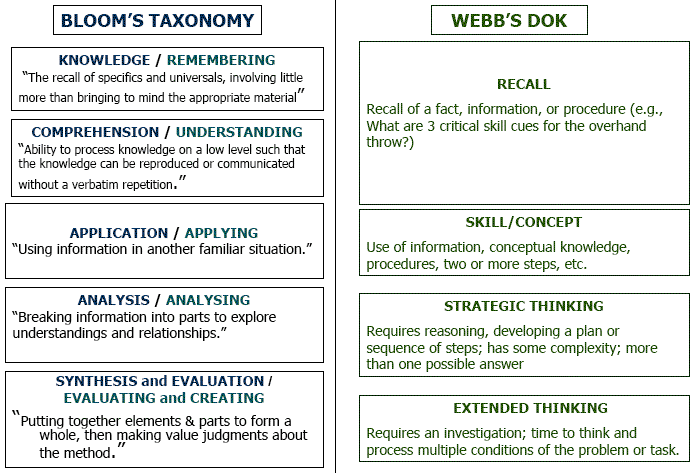
Consider reviewing both Bloom’s and DOK when designing activities especially project-based or passion-based learning activities. You can use Bloom’s in designing and guiding activities that scaffold learning about the content. Ask yourself these questions:
- what prior knowledge do they have about the content?
- do you have to review the information or can you offer multiple ways to provide the content?
- how do you know they understand the concepts? Will you have to repeat the information for some students while others move on?
- how will you measure their understanding before moving on to the next content area?
After learning about who your students are and how they learn best, you can use DOK to go deeper into how they think about their learning. Ask yourself some of these questions:
- do your students have the skills and dispositions to work independently and collaboratively?
- can they find and use the appropriate tools and resources to do research without your support?
- how will you know that your students have developed a plan for learning the concepts and can demonstrate the process?
You can use Bloom’s as a guide for teaching and designing instruction and Depth of Knowledge as a guide for developing skills and encouraging deeper thinking and learning.
How do you see both either working together or separately to support your
teaching practice and the different needs of your learners?
Resources
-
Webb DOK Guide: This pamphlet begins with an overview of the different levels in Webb’s taxonomy, then devotes several pages to each level. There are many suggested activities for each level of DOK which can help you develop activities in your class.
- Francis, Erik. (2016) Now That’s a Good Question! ASCD/
http://www.tinyurl.com/nowthatsagq - Miller, K. Bloom’s Taxonomy and Webb’s Dep of Knowledge. Retrieved. Nov. 2018. https://www.synergiseducation.com/blooms-taxonomy-and-webbs-depth-of-knowledge/
- YouTube Video – DOK – Rose Marsh, NYC DOE Promising Practice Plus http://www.youtube.com/watch?v=WMqKN7edRcU
- Karen K. Hess Cognitive Rigor Matrix comparing Bloom’s and DOK (2009 PDF chart) khess@nciea.org. For the full article go to www.nciea.org
About the author
