

Stay Connected with Grow Your WHY
Recent Posts

Archives
Ikigai: Your Purpose and Reason for Being


Lifespan Study
There is no word for “retirement” in Japan. The Ohsaki Study [2008] found that some of the happiest and longest living people in the world are from Okinawa, Japan. Their average lifespan is seven years longer than in North America. They have more 100-year-olds than anywhere else in the world. Instead of retirement, they have a word called ikigai (pronounced like “icky guy”), which roughly translates to “the reason you get out of bed in the morning.” It’s the thing that drives you the most.
According to the Ohsaki Study, after a 7 years’ follow-up, 3048 of the subjects died. The risk of all-cause mortality was significantly higher among the subjects who did not find a sense of ikigai as compared with those subjects who found a sense of ikigai. [Source: TheStar.com]
Origin of ikigai
In a 2001 research paper on ikigai, co-author Akihiro Hasegawa, a clinical psychologist and associate professor at Toyo Eiwa University, placed the word ikigai as part of the everyday Japanese language. It is composed of two words: iki, which means life and gai, that describes value or worth.
According to Hasegawa, the origin of the word ikigai goes back to the Heian period (794 to 1185). “Gai comes from the word kai (“shell” in Japanese) which were deemed highly valuable, and from there ikigai derived as a word that means value in living.” The concept of ikigai aligns more to seikatsu and, through his research, Hasegawa discovered that Japanese people believe that the sum of small joys in everyday life results in a more fulfilling life as a whole. [Source: Yukari Mitsuhashi]
The Four Elements of Ikigai
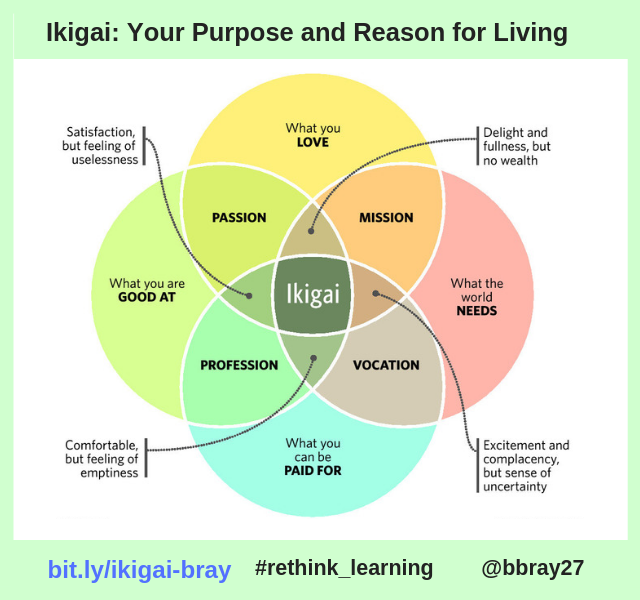
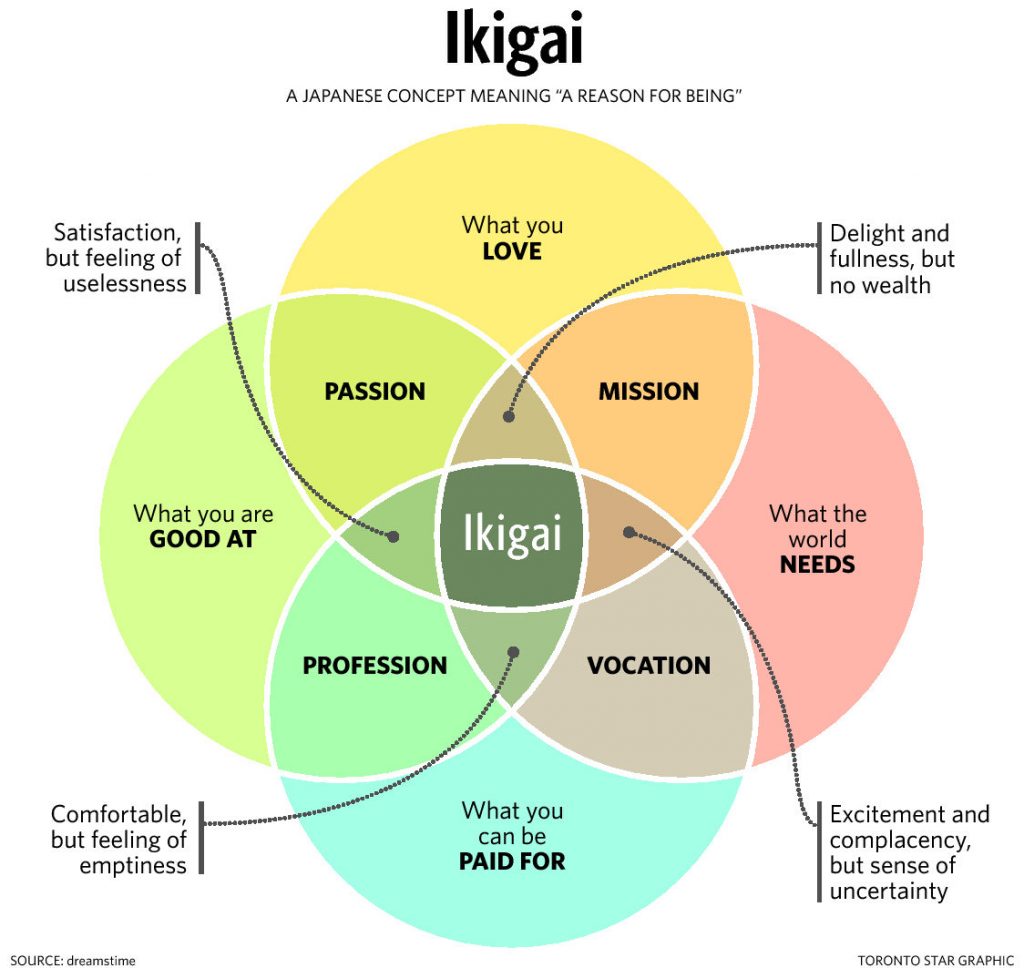
This is similar to passion but holds a strong “purposeful” connotation. The Japanese see the discovery of your ikigai as requiring a deep, long search within yourself that can bring about satisfaction and meaning to life. Ikigai has nothing to do with income. Start with these four primary elements to determine your reason for living:
- What you Love (your passion)
- What the World Needs (your mission)
- What you are Good at (your vocation)
- What you can get Paid for (your profession)
How do we balance all of these factors in the creation of a life which is meaningful, purposeful and aligned with our true calling? Is it possible to have it all? The essence of ikigai gives you a framework to balance these elements into a cohesive whole. While you can make lists of the four elements above and figure out what it is at the center of them all, finding your ikigai can also be as easy as just stopping yourself throughout the day and ask yourself: Why are you doing this?
Discovering your ikigai can be one of the greatest journeys you can embark on. However, it can be challenging with many ups and downs. Just remember it does not happen overnight. As Diana Ross once said, “you can’t sit there and wait for people to give you that golden dream, you’ve got to get out there and make it happen for yourself.” [Source: Forbes]
Ikigai: Having a purposeful life
Listen to Donovan Livingston’s Harvard Graduate School of Education Student Speech all about purpose in the form of a poem.
This video touched my heart. When you discover your purpose like Donovan shared, you may find your story and share your reason for living.
What is Your Ikigai?
Use the concept of Ikigai (reason for living) to find that sweet spot where your gifts, skills, passions, and values align. Take a moment to draw your own version of the overlapping circles of the ikigai symbol and consider the following:
- What do you Love? What aspects of your life bring you into your heart and make you come alive?
- What are you Great at? What unique skills do you have that come most naturally to you? What talents have you cultivated and what do you excel at even when you aren’t trying?
- What Cause do you believe in? What breaks your heart or pulls at your gut? What change would you most love to create in the world? What would you give your life for?
- What do people Value and pay you for? What service, value or offering do you bring, or could you bring, that brings real value to others? Something people need and are happy to pay for or share some value in exchange?
Take a few minutes to write whatever keywords, phrases, and ideas come up for you in each circle, then look for areas of natural overlap. Reflect on the all of these elements and how they may relate to each other. Bring yourself to the center of the circles and leave space in your mind for whatever impulse or calling may emerge naturally to you. [Source: UpliftConnect]
What is one simple thing you could do or be today that would be an expression of your ikigai?
*****
Interested in checking out more of the Rethinking Learning podcasts and reflections, click on the podcast tab at the top, the logo below, or go to https://barbarabray.net/podcasts/
About the author
