

Stay Connected with Grow Your WHY
Recent Posts

Archives
Teaching and Learning Approaches Chart (v1)


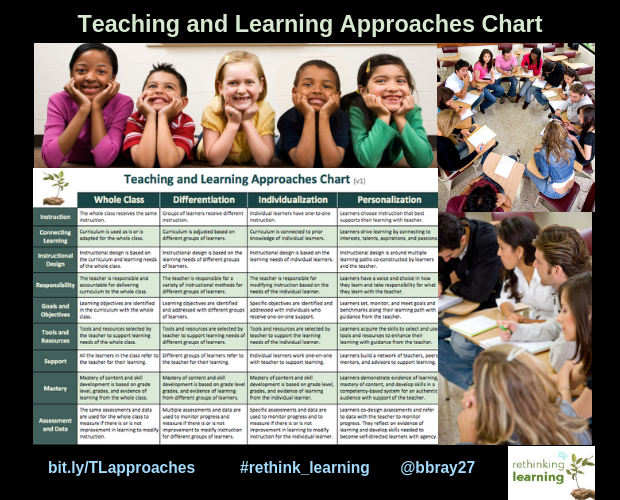
Teachers have so much on their plate. When you ask them to step out of their comfort zone and personalize learning, some throw their hands up and shake their heads. The idea of personalizing learning means something different to different people. Some teachers only heard that they have to change and felt they were being attacked for the way they taught. Others were confused about the terms. Yet, teaching practice is changing because the world is changing. Preparing children for their future means building competencies and skills along with academics. It also means empowering students to take more responsibility for their learning. This is why I created the Teaching and Learning Approaches chart.
The last PDI version 3 chart was created in 2013. That chart has helped educators understand the differences between the terms. Kathleen McClaskey and I worked with schools around the US for over 4 years using that chart in our work and in our books. I am proud of all the work that Kathleen and I did during that time. We decided in 2017 to close our company, Personalize Learning, LLC and go in our own directions to do what we do best. The website for that business was closed in July 2017.
Over several years, I was being contacted by schools and teachers from around the world with questions about the Personalization vs. Differentiation vs. Individualization (PDI) v3 chart. Here are just a few of the questions educators were confused about:
- Why is Personalization in the first column?
- Why didn’t we include the whole class?
- Is it wrong to differentiate or individualize instruction?
- From outside the US, I was asked: “what is the Carnegie unit?”
- Why did we put teacher and learner at the top of the columns?
- How can learners be responsible for teaching and learning?
- What does an assessment OF, FOR, and AS learning mean?
- How can I move to Personalization when my students are not ready?
- How can I help my students develop agency when the system doesn’t allow it?
I then invited educators to provide me feedback so I could help guide the new direction: the Teaching and Learning Approaches chart. What everyone agreed on was that a teacher may address some of the criteria under the different columns and from all of these approaches in a day and maybe even in one lesson. In the work with teachers implementing one lesson or project, teachers may…
- introduce a topic to the whole class.
- provide resources and support for different groups.
- work one-on-one with individual learners.
- encourage learners to have a voice and choice.
Personal or personalized learning is when learners drive learning with support from the teacher. You can use either term “Personal Learning” or “Personalization” because they mean the same thing. The confusion brought up questions about who owns and drives the learning or if the learning is being done BY the learner or TO the learner. Some organizations feel more comfortable using the term “personalization.” All of this is up to you and how you want to adopt any of these approaches in your teaching practice.
I didn’t want to argue over semantics so what I tried to make clear in this chart is how much value a teacher is in all of the approaches and that it is all about the “person” who is learning. That can be the teacher who is also learning about changing their teaching practice. Moving to learner agency takes time for students and teachers. Students may not be ready to let go. Many have learned how to do school and may resist change. Teachers may not have the support, resources, or time to jump in and change how they teach right away. It was clear to me from the feedback how important and more effective scaffolding the skills was for teachers to gently nudge and empower students to take more ownership of their learning. When teachers and learners build positive relationships first and a culture where everyone’s voice is valued, they will know when to change and try new ideas. This chart is meant as a guide and to calm the fears about changing what they know and do around teaching and learning that I heard from teachers.
I added a link to Download the chart for free from the website if you are not a member of SlideShare.

Please let me know what you think of this chart and how you might use it. You can either email me at barbara.bray@gmail.com, use the contact me on this site, leave a comment below, or share on social media.
I will be sharing more materials and professional learning opportunities soon, so if you would like to subscribe, go to the top left to connect so you’ll receive updates, announcements, and resources in the Rethinking Learning Report.
*****
For all of the Rethinking Learning podcasts with Barbara Bray, click on the podcast tab at the top, the logo below, or go to https://barbarabray.net/podcasts/
About the author
