

Stay Connected with Grow Your WHY
Recent Posts
Archives
The Art of Living in the Question with Melanie Ching (EP167)


Podcast: Play in new window | Download
Subscribe: Spotify | TuneIn | RSS
Melanie Ching is a life-long educator and learner. She is passionate about play, curiosity, and using ed-tech to amplify student voice. The way she does this is by tinkering, designing makerspaces, and living in the question. A maker enthusiast, she believes intentionally designing environments where learners are free to tinker and experiment builds stronger communities and richer connections.
Your WHY
I believe, with my whole heart, we need a lot more kindness, compassion, and empathy in this world. We each have spaces that we can hold for this to happen. For me, that space is education. I am passionate about designing environments for curiosity and experimentation, whether in my classroom or a makerspace or currently in the online community I manage. That environment sets the conditions for deeper connections with ideas and with each other.
Your Background
I’ve always been a curious learner. My grandmother taught me to read at a young age, unlocking the puzzle of language and sparking a love for exploration that has shaped every part of my life. As a child, I loved looking through stacks of National Geographic magazines and encyclopedias of wild animals—not because I had to, but because I was fascinated by how the world worked.
The school was a mostly safe and fun place for me, and I thrived in what we’d now call a traditional environment. I did well enough academically and socially that I never questioned how I was being taught—until college when I had my first glimpse of what education could truly be. In my teacher preparation program, I was immersed in a school-based model where our professors came to us, and we learned in the real environment of a working school. In fact, at that same time, the school itself was on a renaissance of its own, relooking at its beliefs about learning that would eventually culminate in it becoming the first public conversion charter school in the state of Hawaii. That experience—where learning wasn’t just theoretical but deeply embedded in a community—set the foundation for everything I do now. It taught me that the spaces we create matter just as much if not more than the content we teach.
I graduated from the University of Hawaiʻi at Mānoa with a Bachelor of Education in Elementary Education, and I moved to Kona on Hawaiʻi Island. There weren’t any teaching jobs available at that time that didnʻt require an extremely long commute, so I worked temporarily in Human Resources, training new employees and welcoming them to the team. A year and a half later, I got an interview for a teaching position on Oʻahu at the same school that hosted our teacher training program. I was hired and began working there while completing my Master’s in Education at Chaminade University. That school eventually became my “home” for more than two decades.
Your Family
My husband and I were blessed with two boys, now adults (23 yo and 19 yo) pursuing their interests. One is in Washington working and looking for a pathway that involves helping people. The other is in Hawaii in his first year of a culinary arts program. I also have several nieces and nephews in different stages of figuring out their life paths. I’m grateful that I get to see their journeys unfold. Seeing this also underscores the importance of the work we do in education, particularly centering students, listening to their needs and passions, and then helping to clear the roadblocks.
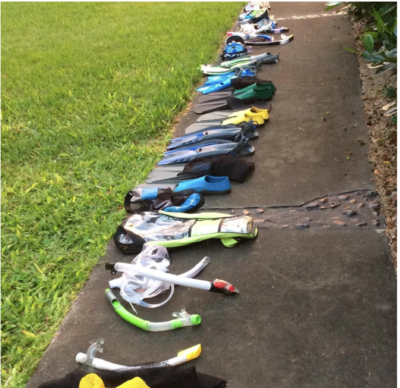
The walkway at my mom and dad’s house in Kona after a beach day
with all their grandkids and their snorkels and fins.
My parents are a constant in my life and influence how I view education. Though not educators by trade, how I was raised and how I see them walk through life has shaped my philosophy, and they have been my greatest teachers. I lean towards a servant leadership style my mom practices daily in how she listens, asks thoughtful questions, and supports others so selflessly. My dad teaches through experience; rather than telling, he shows, allowing learning to happen through observation, trial, and reflection in a safe and supportive way.
Your History as an Educator
 For 23 years, I worked at Hawaiʻi’s first public charter school, beginning as a fifth-grade teacher, then the Technology Facilitator and Coach, and eventually ending my school tenure in administration. My journey with the school ran deep. It was where I completed my teacher training, taught for over two decades both in and out of the classroom, served on both the school board and foundation, and where my children attended as students. These personal and professional ties fostered a profound commitment to the school’s success and growth.
My time in the classroom as a fifth-grade teacher was formative. I was part of an amazing team that cared deeply about our learners and who they were as human beings. They were creative, innovative and so generous with their time and energy. The way they mentored me informed how I chose to approach education and I will be forever grateful to them.
I also had two heads of school with very different leadership styles, but a common thread that ran through their leadership was the enormous amounts of trust they placed in their teachers. One of those leaders knocked down a wall for us so that we could team teach more effectively. The other pushed me to share my work publicly with educators beyond our school and facilitated opportunities to make that happen. That’s what great leadership does—it creates environments where people feel empowered to explore, tinker, and grow.
Technology Facilitator and Coach
After my time in the classroom, I transitioned into the role of technology facilitator and coach, a position I held for six years. During this time, I championed the integration of technology to enhance learning experiences for students and professional growth for teachers. I reimagined the traditional computer lab as a makerspace and spearheaded the expansion of that space, along with the school library, into a Learning Commons that served as a hub for creativity, innovation, and collaboration. One of my main goals at the time was to create a space where all learners could “live” our school vision of being creative problem solvers, self-confident risk takers, well-rounded, collaborative, and socially responsible to others and the world. We wanted to create an environment that, as deeply as possible, allowed them to learn from their strengths, passions, curiosity, and wonder.
Assistant Head Of School
The administrative position focused on the components of school that impact learners but are not academically focused. I managed food services, facilities, and office operations, and had input into the budget. My North Star was to give input and make clear decisions that were grounded in the mission and vision of our school. This role helped me to better understand the workings of our system and how all of the components supported student learning.
What School Could Be
In 2021, I was encouraged to apply for the Director of Community and Engagement at What School Could Be as they had a small team and their operations were growing. Initially in this role, I was charged with the care and nurturing of the WSCB online community and outreach on our social networks. Eventually, it expanded to newsletter writing, planning online events, and more content creation. Currently, as the Global Knowledge Curator, I am still responsible for the online community and the other projects but have turned over the reins of our social media tools, and now take a 30,000-foot view of the different content we have available at WSCB and how to best make it accessible to educators.
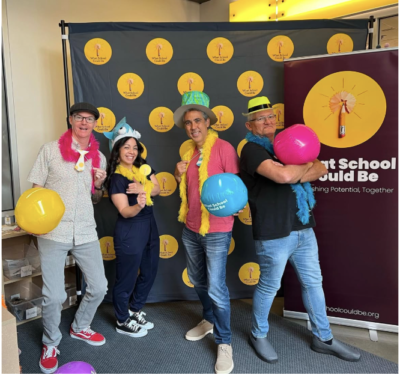
Part of the What School School Could Be Team
at Deeper Learning 2023
https://community.whatschoolcouldbe.org
What School Could Be serves as a connector between individuals and organizations that are doing the work of change despite the slow-grinding wheels of the educational system we are in. We seek to do this by spotlighting the inspiring stories and elevating the voices of educators. The hope is that by gathering everyone together, we create a snowball effect, effecting change for our youth.
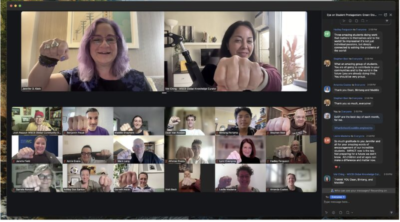
Behind the scenes and a Student Protagonism event,
we host at What School Could Be.
Tinkering and Makerspaces
Tinkering is often looked at negatively, as a way to make small changes but not enough to have any sort of real impact or improvement. But tinkering in terms of the maker movement is so much more. It is about exploring creatively without any artificial constraints on time. It is about honoring the journey and the process. People who tinker experiment with materials and ideas to better understand them, and through this understanding, they can solve problems more creatively and hopefully, more compassionately and empathetically. I love the quote, “Tinkering is the art of living in the question.” It feels like such a brave way to exist.
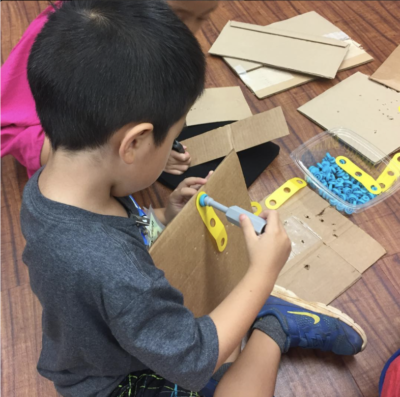
Our Kinders using MakeDo Cardboard Construction tools
I am a huge proponent of makerspaces. Oftentimes, makerspaces are defined as the physical space and the tools within it. More importantly, as Dr. Gary Stager says, a makerspace is a stance on education. All learners are creative and deserve access to spaces that nurture that creativity. Makerspaces aren’t just for “gifted” students, or simple extensions of STEM lessons in the classroom, and they should most definitely not be used as rewards or punishments.
Makerspaces are the embodiment of process over product and an essential part of the learning experience.
What’s next
At some point in the future, I’d love to return to the classroom in some way—to mentor, coach, or work directly with students again. Teaching will always be at my core. But for right now, What School Could Be is doing some very important work not just helping to connect teachers and resource them, but advocating for our youth and elevating their voices. We have an incredible team there and I am excited and grateful to be part of that.
Melanie Ching’s Contact Info
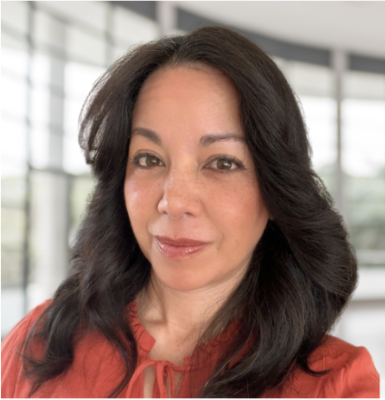 LinkedIn: melanie-ching-998407b/
X: @melching5
Bluesky: @melching5.bsky.social
Email: mel@whatschoolcouldbe.org
WSCB Community: https://community.whatschoolcouldbe.org
*****
I hope you enjoyed my conversation with Melanie Ching who I met on social media and when I was a guest on the What School Could Be podcast. When Mel was a guest host on the #Rethink_Learning chat, I got to know her better and wanted to learn more. I am grateful that Mel shared her story and her WHY on my virtual porch. I know you will find her journey interesting and inspiring Please share this post and podcast with your friends and make sure you connect with Melanie Ching.
*****
About the author
