

Stay Connected with Grow Your WHY
Recent Posts
Archives
Skills and Dispositions Needed for the Future


Forty-six percent of U.S. employers are having a difficult time hiring because they can’t find the skills that they actually need in the workforce. [Source: Mind the Skills Gap] The push for a four-year degree is not filling the skills gap that the world is facing. In the Future of Jobs Report, the World Economic Forum (www.weforum.org) shares the Top 10 Skills needed over a 15 year period.
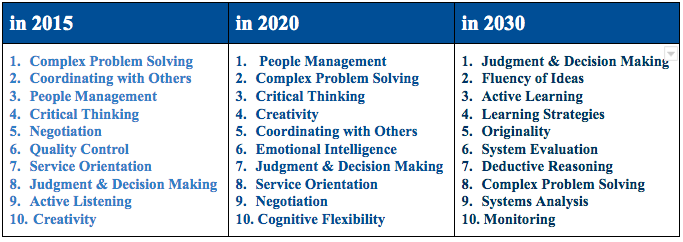
You may not see how the skills employers are looking for have changed from 2015 to 2020, but have we taught those skills listed under 2015. Project-based learning (PBL) activities do encourage working on complex solving problems and coordinating with others. If you collaborate on a project, you need to know how to determine the best person for the task, support each other, brainstorm ideas, negotiate, and possibly compromise on issues. Did you experience these activities as a learner or a teacher? Are you coordinating with others to design global projects?
2020 is almost here. When you review the skills listed in that column, what do you notice?
- Are there some skills missing?
- Do you believe you have these skills?
- Will your students acquire these skills by the end of 2019/2020?
- Where do you see the gaps in their learning?
Let’s think about 2030 and the skills they are projecting people will need by then. Now consider that your kindergarteners (5 and 6-year-olds) will be 10th and11th graders by 2030. We cannot wait until they are in high school to build these skills. That’s too late. We need to start early, maybe in Pre-K to prepare our kids for their future now. They need these skills while they go through school and for what they will need in their lives. The world is changing so fast.
“Consider that your kindergarteners (5 or 6-year-olds)
will be 10th or 11th graders by 2030.”
With disruption driving workforce changes, human, business and digital skills were now considered foundational for the new economy, with an ‘ability to learn’ seen as a graduate’s most valuable asset. LinkedIn Asia Pacific Senior Director Jason Laufer said the company used information from its 650 million members and 1.3 trillion bytes of data to predict future work trends. He said the world had changed, with people now working to learn, not vice versa.
“Roughly 65 percent of jobs for the next generation doesn’t exist today but focusing on soft skills will help you get the hard skills,” he said. “Our biggest learning adventure is to ‘unlearn’ – getting rid of our biases to learning new things.”
[Source: Knowledge is Power: Skilling Students for the Future]
With the workforce changing so fast, we will see careers and jobs going away sooner than later. Today’s workers will need to develop new skills and dispositions before they lose their jobs. This involves dispositions that are a person’s inherent qualities of mind and character. You have to be willing to change. If it is inevitable that certain jobs will be lost, then including mindset activities that encourage having an attitude of gratitude and developing a growth mindset.
Mindset is an idea discovered by Stanford University psychologist Carol Dweck in decades of research on achievement and success—a simple idea that makes all the difference.
In a fixed mindset, people believe their basic qualities, like their intelligence or talent, are simply fixed traits. They spend their time documenting their intelligence or talent instead of developing them. They also believe that talent alone creates success—without effort. They’re wrong.
In a growth mindset, people believe that their most basic abilities can be developed through dedication and hard work—brains and talent are just the starting point. This view creates a love of learning and a resilience that is essential for great accomplishment. Virtually all great people have had these qualities. [Source: https://mindsetonline.com/whatisit/about/]
This idea of a growth mindset brings about the idea of “upskilling” since people are moving up and changing by unlearning, relearning, and developing new skills.
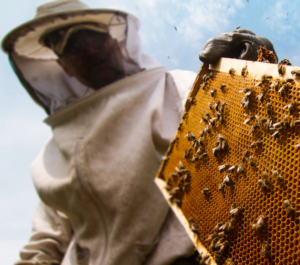
Look at this idea of transforming careers in this article “A Movement to Transform West Virginia Coal Miners into Beekeepers is Great for the Planet.”
*****
For all of the Rethinking Learning podcasts with Barbara Bray, click on the podcast tab at the top, the logo below, or go to https://barbarabray.net/podcasts/
About the author
