

Stay Connected with Grow Your WHY
Recent Posts
Archives
Development of Ownership: From Compliance to Autonomy


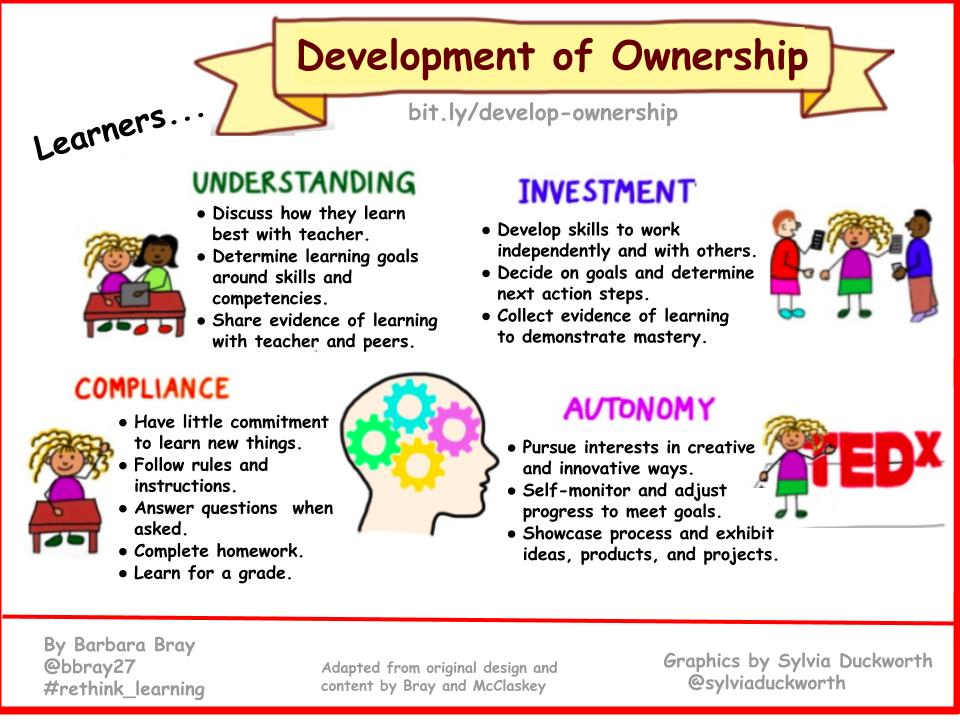 The Development of Ownership by Barbara Bray (2018) is a derivative adapted from the original continuum and content by Bray and Kathleen McClaskey (2015) with graphics by Sylvia Duckworth. The content is licensed under a Creative Commons Attribution-NonCommercial-NoDerivatives 4.0 International License.
This updated post with the new graphic involves anyone who wants to own their learning. I updated the original continuum of ownership because it was not clear in that post and graphic who owned the learning. I took out the references about moving from teacher-centered to learner-driven environments. Learning happens anywhere at any time. Learning is personal. The same with ownership. Ownership is personal. I changed the concept so it was from the learners and not only from the environment. Learners can be anyone at any age including teachers as learners.
Teachers can impact if and when students want to own their learning. Yet, each person needs to feel they are ready to let go of control or when they are ready to take control and ownership of their learning. Teachers may not even know that the control they have over their students affects how and if students want to learn. Compliance was built into the system and we may not even be aware of the control issue.
“When teachers gradually let go of control of what happens in the classroom, that encourages students to want to take more control and ownership of their learning.”
I’ve had many conversations with educators who commented that developing ownership of learning takes time and that it doesn’t always happen in school. Most of us grew up in a system that valued sameness and compliance. In fact, many of the change agents I have had conversations with during my podcasts who are successful entrepreneurs today had similar experiences that I had during their K-12 education. They stated that they did not always have a voice in their learning and found ways to play the game and just “do” school. There was very little or no ownership of their learning except outside of school. Many thought leaders are passionate about encouraging voice and sharing their own stories so students have ownership of their learning because of their own experiences.
The following four phases below and in the graphic above show how any learner moving from Compliance to Autonomy can build the self-confidence they need to own and drive their learning.
Compliance
In the Compliance phase, learners do not feel they own their learning or may not believe they are the ones that have to do the work to learn. They have no idea that they can own or drive their learning at this phase. This is what most of us as learners experienced because “school” was designed for “students” to follow instructions. Since the late 1800s, a school was designed with the teacher as the person responsible and accountable for what students were learning. Students didn’t feel they had a choice in how or what they learned so they just went along and learned how to “do” school the way they were told. I’ve heard students say to their teachers “It’s your job to teach me” or “I just want to get an A on my test.” What have you heard from students that represent compliance? I’ve heard teachers concerned about letting go of control because of behavior issues or having to control the learning because they have to “cover” the curriculum.
When you walk into a class where the teacher owns and drives the learning, the teacher tends to be the hardest-working person in the classroom. You will see walls covered with materials the teacher purchased or created. The teacher is usually doing most of the talking and students contribute to the class by doing what is asked of them.
“Listen more, talk less. If you ask a question, pause and wait at least 10 seconds to give students a chance to think, reflect, and participate in the conversations. “
Understanding
 In the Understanding phase, students share how they learn best with the teacher. Being able to write how they learn and include their interests, talents, and aspirations gives students a voice in what and how they learn. These conversations with the teacher help start the shift of the responsibility for learning from the teacher to the student. The teacher is realizing that when they take the time to learn about each student, they can let go a little. They are reaching out more to each student to understand how they learn best. Students are doing more on their own.
In this phase, students also consult with the teacher to determine what resources, tools, and learning strategies can support what they need to meet learning goals and tasks. Students share evidence of what they are learning as they learn with the teacher and their peers. In this phase, the teacher with the students will choose the most appropriate resources to use and the evidence of learning to share and post on the walls.
Now let’s think about any learner is the understanding phase. This means they are learning about who they are as a learner and exploring new ways to learn new things.
“If you take responsibility for yourself you will develop
a hunger to accomplish your dreams.”
– Les Brown
Investment
 In the Investment phase, students start developing the skills they need to work independently and collaborate with others. They see the value of goal setting with guidance from the teacher to determine the next action steps they will need to progress in their learning. They are now more invested in the process of learning. They know how to identify and choose the best evidence of their learning that demonstrates what they understand and learn.
Walking into a room where students are invested in their learning looks different. This is the phase that validates them as learners. They are focused on completing tasks, reflecting on what they understand, and talking about their learning. They enjoy sharing the evidence they collected or created that demonstrates what they learned.
Consider yourself when you are invested in learning something that you are passionate about. You want to learn more. You are beginning to own the learning because you are invested in and focused on learning about something that is important to you. Relevance, authenticity, and passion impact you as a learner to want to learn more in and outside of school. You may reach out to mentors and learning experiences that stretch your thinking.
“By becoming self-aware, you gain ownership of reality; in becoming real,
you become the master of both inner and outer life.”
—-Deepak Chopra
Autonomy
 In the Autonomy phase, students as learners have acquired the skills and now have the self-confidence to work independently and collaboratively with others. By using innovative and creative strategies, learners extend their goals to now pursue their interests and passions to discover their purpose for learning. They are determined to self-monitor their progress as they meet their goals. Learners identify something they are interested in and completely involve themselves in the process. Autonomy means they are learning because they are motivated to learn.
When you talk to learners in this phase, you can hear the excitement in their voices. Learners want to share what they are doing throughout the process and look forward to showcasing and exhibiting the process and products to peers, family, and possibly a global audience. When learners have autonomy, they own and drive their learning. Autonomy means that learners have agency.
“Do your thing. Do it unapologetically. Don’t be discouraged by criticism. You probably already know what they’re going to say. Pay no mind to the fear of failure. It’s far more valuable than success. Take ownership, take chances, and have fun. And no matter what, don’t ever stop doing your thing.”
— Asher Roth
Barbara McCombs, Ph.D., from the University of Denver, states in her research Developing Responsible and Autonomous Learners: A Key to Motivating Students that motivation is related to whether or not learners have opportunities to be autonomous and to make important academic choices. Having choices allows children to feel that they have control or ownership over their own learning. This, in turn, helps them develop a sense of responsibility and self-motivation.
This approach that McCombs states in her research demonstrated how learners can move from compliance to autonomy by teachers creating a learning environment that provides learners with choices and opportunities for growth and ownership of learning. When a learner at any age pursues an interest that they are passionate about, they are motivated to learn and own their learning. When learners own and drive their learning, they want to become more independent and eventually self-directed learners.
“Who owns the learning?” — Alan November
Who owns the Learning: Preparing Students for Success in the Digital Age
****
I want to give a big thank you to Sylvia Duckworth @sylviaduckworth (http://sylviaduckworth.com) from Toronto, Canada for designing the graphics for the Development of Ownership.
****
Other Websites related to moving to Ownership and Agency
- Spectrum of Voice
- Opportunities for Choice
- Levels of Engagement
- Episode #36: Shift This! to Implement Gradual Change with Joy Kirr
- Teaching and Learning Approaches Chart
- Closing the Skills Gap
- Episode #31: Awakening Wisdom with Linda Inlay
*****
For all of the Rethinking Learning podcasts with Barbara Bray, click on the podcast tab at the top, the logo below, or go to https://barbarabray.net/podcasts/
About the author
