

Stay Connected with Grow Your WHY
Recent Posts

Archives
Accountability vs Responsibility


When it comes to teachers, teaching, and learning, the word “responsibility” seems to be used interchangeably with the word “accountability.” This is more than semantics. There are consequences to being accountable and responsible for someone else’s learning. So what is the difference?
Should teachers be held accountable for what learners are supposed to learn? If teachers are accountable for what their students are learning, are students only learning for their teachers or a grade, not for themselves? Have you ever heard from your students, “Aren’t you supposed to be teaching me?” Some days I just shake my head. How did our kids get so compliant?
Where does intrinsic motivation factor in the equation? Evaluations of teachers are often based on student performance and data, so teachers feel not only accountable but responsible for what their kids learn. Doesn’t this seem backward?
When learners write something they are interested in for an audience of their peers, they are more motivated to write, read each other’s work, and are okay with being responsible for what they learn. You see, in this case, they are driving their learning around something that matters to them.
Responsibility means a moral obligation and something taken upon one’s self.
Most of the teachers I know feel wholly and morally responsible for what their students learn. Most of us went into the profession to make a difference in children’s lives. Is it really a teacher’s responsibility for their students to learn the content?
Accountability is more of a social contract or social obligation. Accountability can be measurable. accountability denotes answerability, for the completion of a task assigned. [Surbhi, 2016]
If these are the correct definitions, then “accountability” refers to making, keeping, and managing agreements and expectations. “Responsibility” is the feeling of ownership. So that’s it! That’s what making learning personal is all about: being responsible for our own learning. Maybe this also means that all learners of any age need to be held accountable for what they learn or do not learn by taking responsibility for their own learning.
Teachers usually feel a responsibility to create an environment that engages and motivates kids to want to learn. Dave Truss (@datruss) wrote on his blog post: Personalization and Responsibility that educators openly sharing in learning communities create an environment where teachers are learners, too. They can model what they want from learners. He stated that when learners and teachers reflect on their own learning and communicate it to each other, they are intensifying their understanding about a topic, their learning strengths, and the areas in which they need to develop further.
In this same post, Dave shared Andy Hargreaves The Fourth Way where we should be focusing more on responsibility with teaching and learning at the top of the pyramid.

Dave Truss elaborated in his post about Hargreaves, ‘The key here is to recognize that there is a coexistence between the two and that this isn’t a dichotomy, but rather a priority: “Responsibility before Accountability.” This is where schools and school districts have the greatest opportunity to change.’
Dave sees the challenge is that a focus on teacher accountability actually takes away learner autonomy and responsibility. Where accountability really matters in the relationship between a teacher and student and their accountability to each other. Authentic learning and authentic assessment matter. Neither of those things happens in a pressure cooker of high stakes testing.
Barbara McCombs, Ph.D., from the University of Denver, stated in her research Developing Responsible and Autonomous Learners: A Key to Motivating Students that motivation is related to whether or not learners have opportunities to be autonomous and to make important academic choices. Having choices allows children to feel that they have control and ownership over their own learning. This, in turn, helps them develop a sense of responsibility and self-motivation.
When learners feel a sense of ownership, they want to engage in academic tasks and tend to persist in learning. If teachers and students are learners first, then responsibility comes with being a learner. Learners of all ages become responsible for their learning when they own and drive their learning.
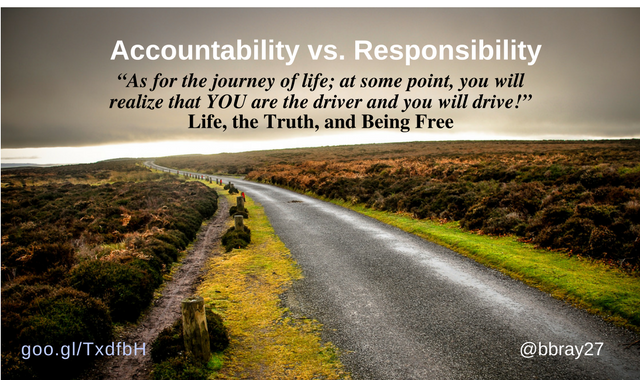
“As for the journey of life; at some point, you will realize that YOU are the driver and you will drive!” Life, the Truth, and Being Free
Teachers and learners need to be accountable for their learning so they take responsibility for their own learning.
What do you see as the difference between accountability and responsibility?
Resources
- Appelo, Jurgen. “Accountable vs. Responsible” Forbes. Dec. 2016. https://www.forbes.com/sites/jurgenappelo/2016/12/08/accountable-versus-responsible/
- McCombs, Barbara. “Developing Responsible and Autonomous Learners: A Key to Motivating Students.”
- Surbhi, S. “Difference between Responsibility and Accountability. June, 2016.http://keydifferences.com/difference-between-responsibility-and-accountability.html
- Truss, Dave. “Personalization and Responsibility.” Pair-a-Dimes. July, 2012. http://pairadimes.davidtruss.com/personalization-and-responsibility/
*****
Interested in checking out more of the Rethinking Learning podcasts and reflections, click on the podcast tab at the top, the logo below, or go to https://barbarabray.net/podcasts/
About the author
