

Stay Connected with Grow Your WHY
Recent Posts
Archives
Episode #3: My Journey into Inquiry by Shelly Vohra, Ph.D.


Podcast: Play in new window | Download
Subscribe: Spotify | TuneIn | RSS
Rethinking Learning Podcast Series Episode #3
Conversations with Shelly Vohra on Her Journey into Inquiry 
Shelly Vohra, Ph.D. @raspberryberet3 shares with Barbara why inquiry connects learners to the real world. She shares how she helps teachers bring voice and choice into the classroom. Shelly shares her story and ideas in the post below.
My journey into inquiry started almost ten years ago. I remember sitting in my Grade 5 classroom at the end of the year, exhausted and thinking, “There has to be a better way to teach the curriculum!”
Connecting Subjects
My main goal was for my students to recognize that the subjects were connected. For example, how are science, geography, language, math, connected to each other? These are not isolated subjects nor are they an island on their own. There are many opportunities for cross-curricular integration, and I had designed and delivered many lessons where students were learning in this manner. However, I felt there was a more effective method in which students could explore issues, topics, and concepts in an integrated fashion, where there were more choices and voices for students. Additionally, as someone who values social justice and equity issues, I wanted to find a way to ensure that social justice was integrated into teaching and learning.
One of My Best Learning Experiences
I never thought the journey that I started that summer would end up being one of the best learning experiences of my life! I remember sitting at my parent’s kitchen table (I was still living at home at this time) with all the curriculum documents spread out in front of me and doing a scavenger hunt of sorts. I was searching for ways in which the expectations in one subject area overlapped with expectations from other subject areas. I was not only looking at the expectations per se, but I was also examining the skills/verbs that were common amongst the different subjects.
For example, how many times did the verbs “analyze, judge, evaluate, and justify” appear in the various curricular areas? I started with the science and social studies curricula since they would be the best ones in which the “big ideas” would come to light. My next step was to generate a list of these “life big ideas” (as I like to call them) and related questions (which we now know as “essential questions” or “driving questions”). Since I was teaching grade 6 the following year, my first big idea was “Development” and my related essential question was, “Should Canada continue to invest in space exploration?” I spent the next few weeks planning this unit; designing lessons, looking up resources, mapping out assessment strategies, and drafting a newsletter to parents about the unit. There are different levels of questions and this is another thing I have learned as my learning progressed. For example, the question above is a yes/no question and might be considered a lower-level type of inquiry question. It is important, however, that these questions become even more open-ended as students become accustomed to learning through the inquiry process.
Using the Inquiry Method
This type of approach to teaching and learning allows students to use the inquiry method. They are introduced to the big idea and essential question and some initial discussions occur in our “community circle”. Students then engage in their learning by accessing the necessary resources (books, newspaper articles, websites, magazine articles, etc) to answer the question. This is not to say that there is no explicit teaching happening during the unit; of course, there is! These explicit lessons just need to be planned carefully in terms of what information is being disseminated to students and when it is being disseminated in the learning cycle. I found that my students were engaged because their learning was self-directed; instead of giving them the answers, they had to find them on their own. In other words, they were constructing their own knowledge and forming their own opinions and views based on their research and their experiences.
I wanted my students to realize that there is no one right answer to these types of questions. One student could argue that we should continue to invest in space exploration while another student would argue that we shouldn’t invest in space exploration but as long as they each have valid and reliable arguments, they are both correct. Furthermore, this type of learning allows students to really listen to each other. We had weekly class meetings where we discussed the question and students shared how they felt. If students disagreed with each other, they did so respectfully and challenged each other by asking good questions (this in itself takes time to build in a classroom!).
Providing Choice Matters
I also provided choice: my students could choose how to present the answer to the essential question. For example, if one student’s strength was writing, he/she could write a persuasive essay; if another student wanted to deliver a speech, he/she delivered it in front of the class, and if another student loved technology, he/she shared their website with the class (my assessment procedures have evolved since then, which I will share in subsequent podcasts and posts).
In the end, my students told me they really enjoyed the unit because they were allowed to express their thoughts and views, collaborate with their classmates, and didn’t have to complete a bunch of worksheets. Based on their feedback, I was determined to ensure that all my units were based around a big idea and essential question.
Guidelines I have learned about writing essential questions:
- Essential questions are concepts in the form of a question
- Essential questions promote inquiry.
- Essential questions have no one right answer, therefore they are open-ended.
- Essential questions depend on the knowledge, prior experience, and questions that students bring to the table.
- Essential questions set the focus for the unit of study
- Essential questions are cross-curricular
- Essential questions promote critical thinking, reasoning, collaboration, communication, etc.
- Essential questions are related to the curriculum.
Factors to Consider
- What prior knowledge do students need to know?
- What do students need to know in order to answer the question?
- What resources can/will they use/access to find the information?
- What instructional strategies best suit this type of learning?
- What types of formative assessments will you have in place to ensure they are learning what they are supposed to be learning?
- How will you accommodate students who are on an IEP or who are ELLs?
- How will you support struggling students?
- In what possible ways can students demonstrate their understanding in terms of answering the essential question?
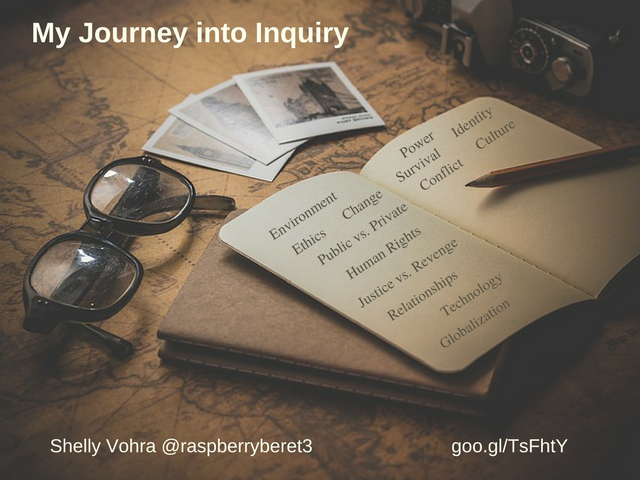
Some examples (Based on Ontario’s Curriculum)
Big Ideas |
Essential Questions |
| Change (all grade levels) | Is conflict necessary for change? |
| Survival (Grade 7) | Does earth have a greater impact on us or do we have a greater impact on the earth? |
| Power (Grade 8) | Is water a right or a privilege? |
I hope this post inspires you and leads to further questions. I’d be happy to engage in further discussions about inquiry, social justice, and inquiry. Please also visit my blog (link below) to read more about inquiry!
******
 Shelly Vohra @raspberryberet3, is an Instructional Coach with the Peel District School Board in Ontario, Canada, with a Ph.D. in Educational Technology. She has been an AQ Instructor for the Elementary Teachers’ Federation of Ontario (ETFO) which includes Math, Reading, ESL, Special Education, Media and presently instructing Math Part Two. Her responsibility as an Instructional Coach is to work collaboratively with classroom teachers by focusing on individual and group professional development that will enhance and refine the understanding of research-based practices and instruction. Shelly is also an instructor at Brock University teaching mathematics to Year 2 teacher candidates and has delivered numerous workshops on technology, mathematics, science, social justice, and inquiry.
Shelly’s Linkedin
Shelly’s Website: techdiva29.wordpress.com
*****
Interested in checking out more of the Rethinking Learning podcasts and reflections, click on the podcast tab at the top, the logo below, or go to https://barbarabray.net/podcasts/
About the author
