

Stay Connected with Grow Your WHY
Recent Posts
Archives
Traveling Toy Animals


Guest Post by Paula Ford @prford5, Kindergarten Teacher,
Manuel De Vargas Elementary School, San Jose, CA
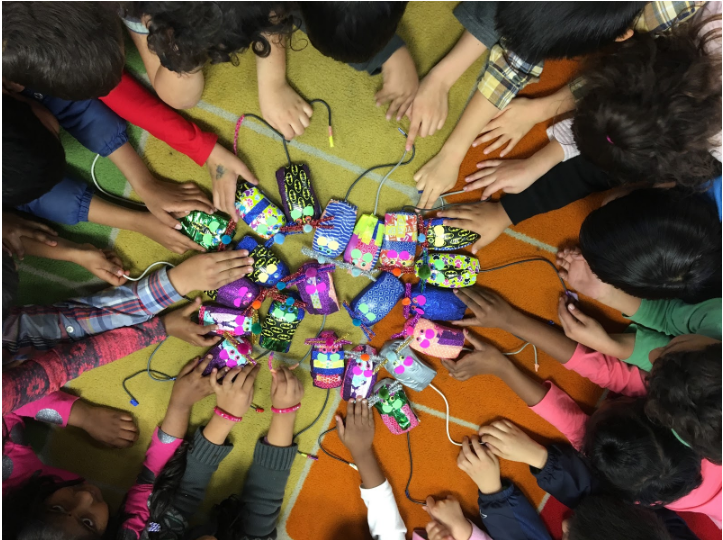
Kinderkids Sharing Toy Mice
I teach at a STEM school with a focus on Project Based Learning (PBL). We are in the third year of this learning process, with the help of Buck Institute for Education (BIE). Our school serves children who speak over 29 different languages. I always find that fact amazing and inspiring.
For those who are thinking about PBL or just starting it, it is like swimming for the first time. You have no idea if you will sink or swim until you try it. Letting your kids take charge of their learning is a huge risk, but the rewards are tremendous. The excitement is contagious. I am as excited about the learning as they are! This post is in the middle of this PBL, but the kinderkids are excited about sharing their journey.
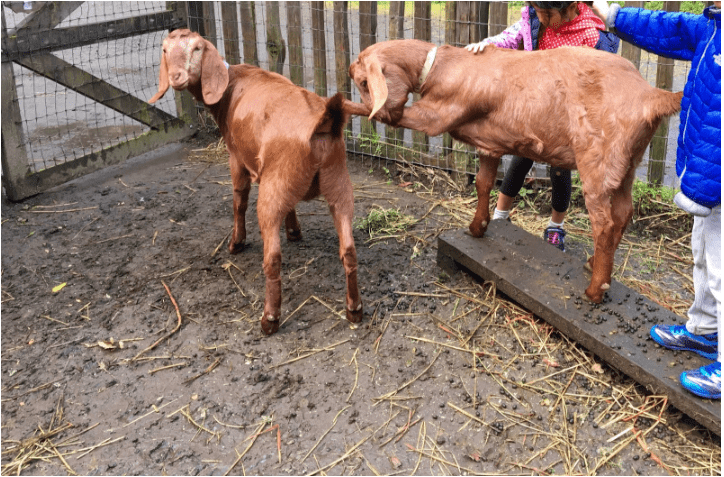
Farm Animals
The Driving Question is:
How is the city and the farm the same and different?
Toy animals are not only a source of comfort for children, they can also provide an opportunity for nationwide collaboration. Kindergarteners will learn about their own community, the city, as well as about life on a farm. The entry event was the book, Town Mouse Country Mouse. We also took a field trip to a farm, to give the children a basic frame of reference for the project. This necessity was made evident on the field trip when the children were asked what animal they thought they would see first on the farm that day. The first answer was, “A hippo.”
After the launch, the children brainstormed what kind of animal they would like to send to a group of kindergarteners in rural Indiana to learn about life on a farm. After much discussion, the children decided to use an actual computer mouse, and turn it into a toy mouse.
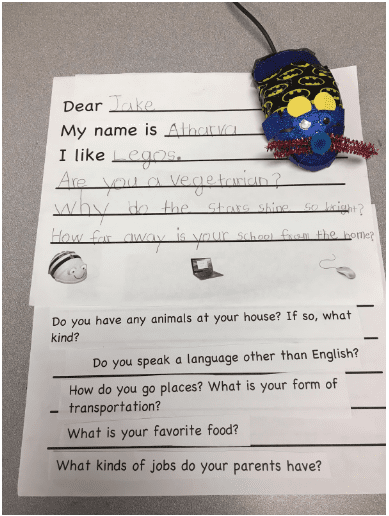
Letter and Computer Mouse
This would symbolize that we live in the heart of Silicon Valley, and technology is a part of our everyday lives. Each child made their very own mouse and wrote a letter to their new friend in Indiana asking questions about what it is like where he or she lives. Our field trip to the farm was an asset in helping the children come up with questions for their Indiana friends. Along with the letters and mice, we sent a video introduction of ourselves.
Before long our package was in the mail, and we anxiously awaited to get ours from Indiana. Shortly, a package arrived from Indiana addressed to us. Inside was a handmade toy horse for each child. They explained they chose to make a horse as they travel to and from school by horse and buggy!
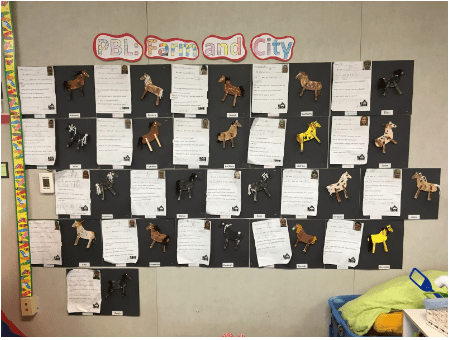
Toy Horses and Letters from Indiana
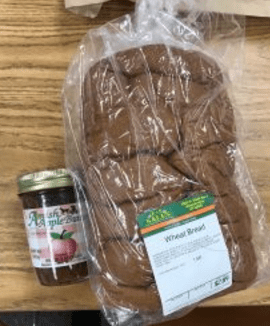
Amish Bread
In addition, they sent us local homemade Amish wheat bread and Amish apple butter. Finally, there was a letter for each child with a set of questions about life in the city. Some of the questions they asked included: if we have skyscrapers, how we learn at school, how we travel to and from school, what languages we speak, what kinds of clothes we wear, what kinds of job our parents do, what kinds of food we eat, what is the weather like, and what is the ocean like.
After the children had ample opportunity to play with the horses and share their letters with each other, we dove into the project of answering their questions. First, we figured out which questions we already knew the answers to, and we answered those first. Next, we made a list of what we needed to learn. We realized we did not know what a skyscraper was. That was a new vocabulary word.
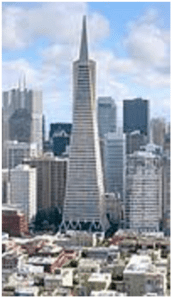
Transamerica Building
We proceeded to learn a bit about skyscrapers. The children learned that skyscrapers are buildings at least 40 stories tall. The tallest building in our downtown San Jose is only 23 floors. This is due to height restrictions from the San Jose airport. However, San Francisco has plenty of skyscrapers. The most famous is the Transamerica Pyramid building, which is 48 floors, or 853 feet high. This discussion included learning about what a pyramid is, one of our three-dimensional math standards.
The children decided to make an iMovie to show our friends in Indiana what life is like in the city. We are including a design challenge in our Makerspace since we think that is something unique to our school.
With our big buddies we designed and created catapults to launch candy hearts. Some of the children are also taking iPads home to spend a day at work with a parent. They are going to video document their experience to share with the rest of us, and we will include that experience in our iMovie.
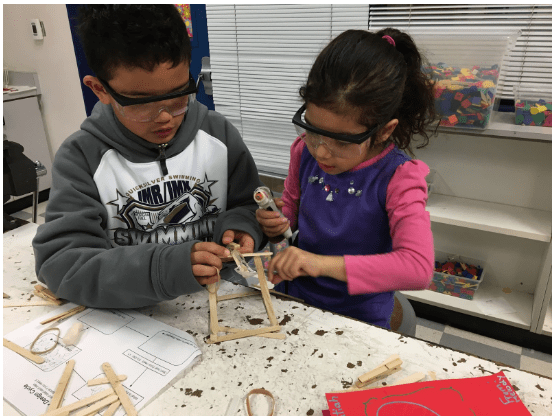
Creating Catapults to Launch Candy Hearts
We are currently in the middle of this PBL, and so far it has been a powerful Project Based Learning (PBL) opportunity because it lets children from across the country learn from each other. Collaboration is occurring throughout this PBL as many of the questions received are similar in nature. Reflection can be seen throughout the process, as children reflect on their experiences and verify they are answering the questions that were posed. This PBL puts children in charge of their learning, as it allows for nationwide communication about the different communities in which kindergarteners live.
Stay tuned to find out what happens when we send our responses back to Indiana and receive their responses to us.
 I graduated from University of California at Davis with my Bilingual Cross-cultural Language and Academic (BCLAD) multiple subject teaching credential, and have been teaching for over twenty years. I began my career in bilingual education, and then moved to teaching second language learners.
I taught kindergarten, first grade, third grade, and have been a resource teacher for grades transitional kindergarten through fifth grade. The majority of my career has been teaching low-socioeconomic English language learners. Currently, I am teaching kindergarten at Manuel De Vargas Elementary School, and I absolutely love it.
*****
Interested in checking out more of the Rethinking Learning podcasts and reflections, click on the podcast tab at the top, the logo below, or go to https://barbarabray.net/podcasts/
About the author
