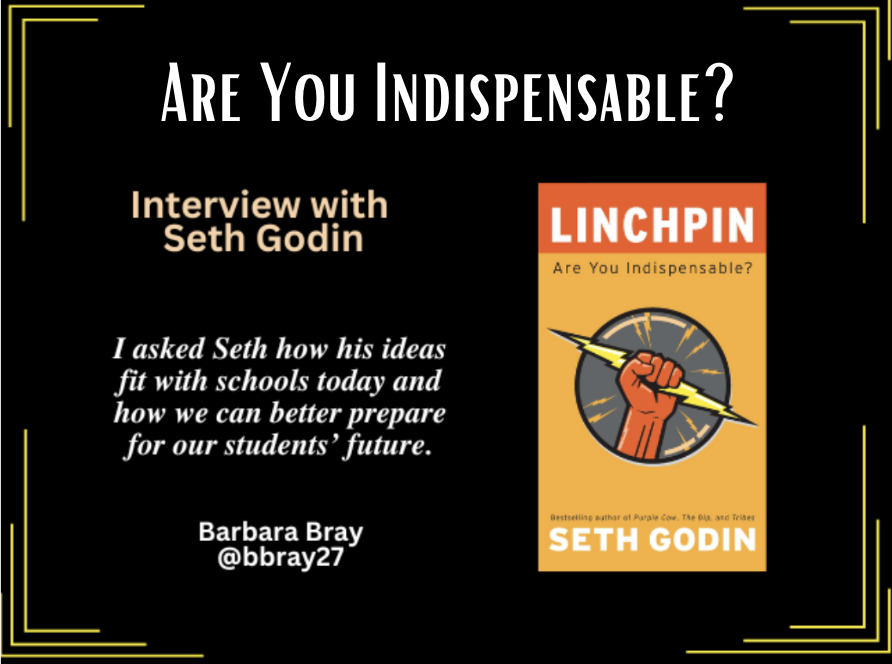
I was one of the lucky few who was given an advance copy of Seth Godin’s book: Linchpin: Are you Indispensable? His book hits home for me especially involving education. I asked Seth how his ideas fit with schools today and how we can better prepare for our students’ future.
****
Q1. Since I work with educators, I am curious how you see teachers leading this change to more of a gift-giving and artist model. How do you see teacher education in the future as it relates to this model?
Seth: Teachers are the key to the whole deal. All successful people I know can name one or two or three teachers that had a huge impact on them. But why three? Why not thirty? Why is it that the rest of the teachers were competent at giving exams and getting us to do well at those exams, but didn’t teach us enough to change us?
The system has hamstrung teachers and handicapped those that want to stand out and make a difference. And yet a few still stand out.
What happens when more teachers realize the opportunity and start challenging the status quo? Until that happens, we’re in real trouble.
I think we can’t wait for the teacher’s colleges to change, or the schools to change. We need teachers to care so much that they can’t stop pushing until they create change in the students who really need (and deserve) it.
Q2. Universities take the longest to change. Does everyone need to take classes with the information they mastered already? How can university students set their agenda, challenge material they know already, and demonstrate what they understand?
Seth: Here’s what’s going to make universities change: we’re going to stop going. We’re going to stop paying. Once people realize that Full Sail and the U of Phoenix can deliver the same thing (or better) for much less money, the panic will set in, for the first time in five hundred years Universities are going to have to do something new. I think this will happen in the next thirty years.
Q3. Education tends to be a top-down driven model where administrators, standards, policies, and test scores drive what teachers teach. How do you see education changing with this model where the individual sets their agenda?
Seth: As a student in a digital world, tell me again why I need the building. The administration? The system?
I don’t. And as accreditation becomes less meaningful because it’s easier to test the student than to test the system, the top-heavy organizations will falter. And fast.
Q4. There is a movement in social networking and Web 2.0 circles where individuals are responsible for their learning. They build their personal learning network, use and share free resources, and find information from their connections. Is this an example of how individuals will set their agenda for their own learning? How do you see emerging technologies impacting teaching and learning?
Seth: I think this is going to happen, but I think it’s more likely that individuals with something to teach will set up their digital schools. I offered an MBA last year to nine students, and it had an enormous impact (on me and on them). Multiply this by 1000 people in each field, and you have both an industry and a new way of learning.
Q5. Schools today tend to require that everyone is on the same page. What age or grade level do we start teaching children to see? How would you teach individuals to find the artist in each of us?
Seth: Is there a number less than zero?
The job of school should be to teach people to solve interesting problems and to teach people to lead. We should start doing both in Kindergarten. The job of parents is to augment and amplify this, and, at the same time, stop yelling at schools about test scores. Test scores are a sucker’s game, the refuge of systems that can’t imagine a better way to measure, encourage and push kids to be brave and essential.
Q6. It seems like you may have to create some models demonstrating how a school can prepare its students for the 21st century. Do you know of any schools that already use your model?
Seth: Some schools and some teachers have been doing this for a long, long time. The Putney international program in Vermont, or certain classes at the School of Visual Arts. We often find pockets of innovation, long-suffering teachers, or small counter-culture institutions that seem like oddities until we realize that what they do actually works. Loren Pope wrote about 40 Colleges That Change Lives, and I think he had it right. We know how to do this, but we often don’t have the guts.
Q7. Do we need to continue the industrial education model (school buildings open 9-3, students at specific grade levels, teachers in classrooms, and summers off), or do you have new models for education based on your ideas of giving, sharing, and artists that set their own agendas?
Seth: I think the reasons for the model you talk about left the building a long, long time ago. We need a system that permits parents to work, kids to grow, problems to be solved and a difference to be made. It’s not clear to me why we decided to leave so many gaps in the system we’ve created (oh, no school today, see ya!) and at the same time, why we’ve insisted on a deadening march to mediocrity. It’s sort of pathetic how we’ve abdicated responsibility to a leaderless system that’s accountable to no one in particular.
Q8. How do you see job training in the future?
Seth: I guess it depends on how we see jobs in the future. I think there are some things that the jobs of the future have in common, and I hope that we can start measuring this and focusing on this and stop obsessing about the length of the hypotenuse.
1. Solve interesting problems.
2. Be self-reliant.
3. Find the information you need from the Net and other places.
4. Connect.
5. Lead.
6. Invent.
7. Fail.
8. Learn from #7 and repeat.
How much time do we spend on that agenda today?
Q9. If everyone gives their products and ideas away, then what is the revenue model for this new type of artist?
Seth: If everyone did anything, that thing would be pretty worthless. Even brain surgery. Here’s the thing: everyone’s NOT going to do it, not for a long time, because people are ill-trained for it and afraid of it.
Right now, the more you give away, the more you get. People flock to things that are wonderful and pay to cut the line, pay to get access and pay for souvenirs and bespoke items. It’s not a theory, they do. Once you cut overhead (and how much of higher education is essential?) there’s plenty of room to generate income.
****
This is Barbara
I hope you enjoyed the interview with Seth Godin. I was part of a WebRing with 20 others who posted this at the same time in 2010. It was originally on My eCoach. I brought it over here in 2012 to share it with you. Please share it with your friends.
****