

Stay Connected with Grow Your WHY
Recent Posts

Archives
Why is Change so Complex?


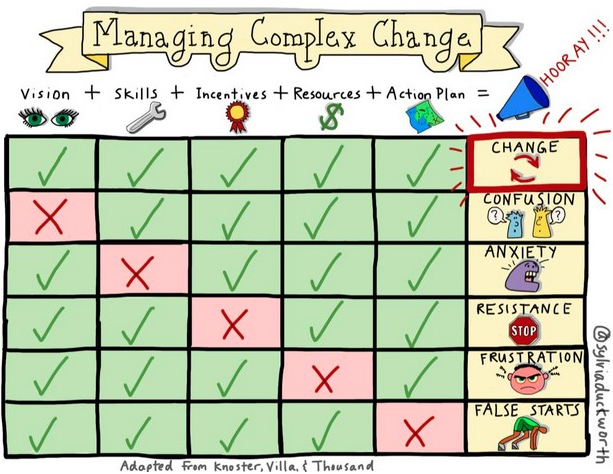
This visual from Sylvia Duckworth @sylviaduckworth makes it easy to interpret and evaluate the change process.* These images visualize the reactions people have during the change process. If the leadership team and others working on transforming their system review this process, they can monitor and consider what needs to be done to get a derailed changed strategy back on track.
Changing or transforming any system especially in education is not an easy thing to do. If you are part of a system that most of us grew up in and are used to, it doesn’t take much to keep your school or district from moving to any new system or changing much at all. The change process is so complex that even if you agree and are working on transforming the system, there may be one piece of the puzzle that is missing that keeps change from happening.
I took each of these elements apart to go a little deeper in the change process.

What if your vision is only your vision and others don’t believe in it? If all stakeholders are not on board or don’t understand what this change means for them, then there is confusion and, possibly, resistance. The idea around student-centered learning IS confusing because multiple organizations and groups have different definitions of what personalization means.
What if we think of learning first?
Our focus for so long has been on teaching, curriculum, assessment, that we forgot why and who we do this for. We need to teach kids, not subjects. It is about each student, teacher or any learner, how they learn best, and providing a learning environment that supports their learning goals. For change to happen, there needs to be a vision with a shared belief system that focuses around each learner. We have to remember that teachers are learners too. Teachers are overwhelmed so we need to step back and see how they can have a voice in the vision for change.

It is much easier for people to continue with the status quo which some refer to as “what we do here.” Change requires people to move out of their comfort zone and try something new. Because of all the mandates, standards, tests, etc., teachers keep getting more on their plate. So some teachers push back when they hear they need to do something on top of all the other things they are doing. Or they may not feel they have the skills needed to change. This can cause anxiety and fear of this change. People may be concerned that they will be the ones responsible and accountable for what happens after they change. This is where teachers need time, training, and ongoing support so they have the skills to make this change.

There has to be an incentive to change. That means that teachers need to see the value of changing how they teach and what’s in it for them. If there are no reasons or incentives, they are bound to be resistant to any change especially if it is just adding more to their plate. Incentives also involve how you build consensus around the vision. I mentioned time under skills. Time is a big one for teachers. They have so much on their plate now but to make any changes, they need the ability to take some risks and not be punished if something they try doesn’t work. It might mean replacing what they do now with a new approach to teaching and learning. Support is another incentive. Look at asking teachers that have changed to mentor others or model what they do so teachers feel supported along the way as they change.

The idea of changing a system can get everyone excited to move it forward or just the opposite: complete resistance. Resources are the necessary things that people feel they will need to carry out the change needed to personalize learning. These resources could be physical resources like technology or funding and emotional resources like coaching and time. Without these resources, teachers and students become frustrated and have a feeling of hopelessness. They can develop a fixed mindset that change will not work for them. The change cannot happen without these resources so some teachers believe “why even attempt to make this change?” Be willing to research existing resources and identify new resources that will be needed to support the change you want to happen.
“If you don’t know where you are going, you will never get there.”

Without a clear action plan, people will experience false starts – a sense of being on a treadmill, and not really being able to get any traction or going anywhere. This is when you invite all stakeholders to include their voice so they have a feeling of ownership. Ask for their input and feedback. All of us are learners and to create and sustain a system that is learner-centered, you need measurable and achievable goals to meet the action plan.
*——– The graphic at the top by Sylvia Duckworth (@sylviaduckworth) was adapted from the work of Ambrose in Managing Complex Change and from A Framework for Thinking About Systems Change by Timothy P. Knoster, Richard A. Villa, and Jacqueline S. Thousand, that appeared in Restructuring for Caring and Effective Education: Piecing the Puzzle Together
*****
Interested in checking out more of the Rethinking Learning podcasts and reflections, click on the podcast tab at the top, the logo below, or go to https://barbarabray.net/podcasts/
About the author
