

Stay Connected with Grow Your WHY
Recent Posts


Archives
Being in the Flow


When I think about engaging students, I think about Flow. Flow is the mental state of operation in which a person in an activity is fully immersed in a feeling of energized focus, full involvement, and success in the process of the activity.
In 1997, Mihaly Csíkszentmihályi published this graph that depicts the relationship between the challenges of a task and skills. Flow only occurs when the activity is a higher-than-average challenge and requires above-average skills.
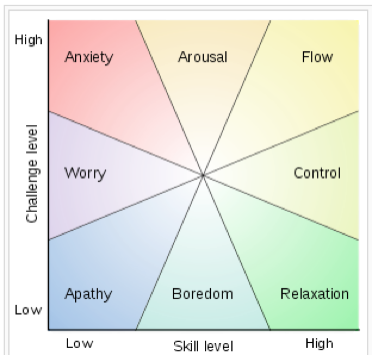
Graph of Flow from Wikipedia: http://en.wikipedia.org/wiki/Flow_%28psychology%29
The center of this graph (where the sectors meet) represents one’s average levels of challenge and skill. The further from the center an experience is, the greater the intensity of that state of being (whether it is flow or anxiety or boredom or relaxation). Flow only occurs when the activity is a higher-than-average challenge and requires above-average skills.
Kindergarteners spend more time learning how to take a test than learning how to socialize. Watch children play and challenge themselves. You can see how they are engaged. Play and learning need to go hand-in-hand. If play is purposeful and challenges the learner, any learner of any age will want to learn.
“We don’t stop playing because we grow old; we grow old because we stop playing.” — George Bernard Shaw (1856-1950)
Conditions of FLOW
Mihaly Csíkszentmihályi identified ten factors one may experience with FLOW:
-
- Clear goals and expectations
- Deep concentration
- A loss of the feeling of self-consciousness
- Distorted sense of time
- Direct and immediate feedback
- The balance between ability level and challenge
- A sense of personal control over the situation or activity
- Intrinsically rewarding activity
- A lack of awareness of bodily needs
- Absorbed and focused only on activity
How are you experiencing FLOW?
Think about an activity that gets you excited and are passionate about. If you love mountain biking, you probably cannot wait for that time to jump on your bike and take off. If you are working on a project that you are really interested in, you might work right through your lunch and not even know it. If you are part of a team and are valued, it makes you feel important. If the project you are working on is something you want to do or want to learn, then you spend even more time on it than you would in a traditional classroom setting.
How are your students experiencing FLOW in the classroom? Are they? If so, when?
I am a coach. I work with teachers to facilitate moving teaching and learning to student-centered classrooms. This isn’t easy for teachers especially with everything else on their plates. When teachers develop an activity that is student-centered and their students drive and own their learning, the environment changes. The noise level in the classroom gets louder. For some teachers this is bothersome, but that’s just because they are not used to it.
I call it controlled chaos and purposeful play. There’s a buzz going on in the room. When students are working in groups and fully engaged, they enjoy working as a team. Especially if each member of that team has a role and is valued in that role. I’ve seen middle school classrooms change from a group of at-risk students who are not interested in anything to learners who are excited about learning. I’ve seen them stay during lunch or after school to continue to work on projects. Now that’s FLOW!
You can see FLOW happen when students are working in groups or doing individual work. FLOW is personal. Learning needs to be personal. It really is all about the learner.
*****
Interested in checking out the Rethinking Learning podcasts and reflections, click on the podcast tab at the top, the logo below, or go to https://barbarabray.net/podcasts/
About the author
