

Stay Connected with Grow Your WHY
Recent Posts

Archives
The Continuum of Self-Efficacy


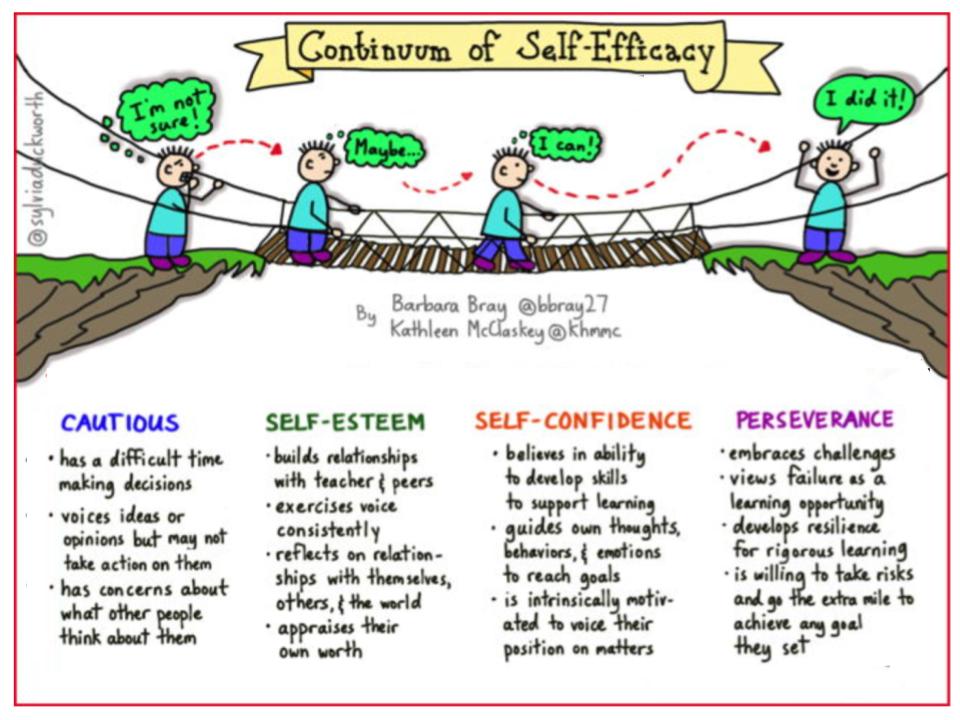
The Continuum of Self-Efficacy graphic was designed by Sylvia Duckworth @sylviaduckworth with content by Barbara Bray and Kathleen McClaskey. The content is licensed under a Creative Commons Attribution-NonCommercial-NoDerivatives 4.0 International License.
Self-efficacy holds significant implications both for learners and educators in the journey to nurture high levels of skill and knowledge. The most difficult and challenging learner to teach is the learner who believes he or she cannot succeed.
For this learner, developing challenging and complex skills and concepts is a task to be avoided. If success does not come on the first attempt, these learners easily conclude that learning is not possible and abandon their efforts. (Bandura, 1986; Bandura, 1991) Often, learners with a low sense of self-efficacy try to hide and go unnoticed in classes or even misbehave and act out to avoid the embarrassment and pain of being exposed as not being able to learn what is expected of them.
Cautious
Cautious is when a learner has a difficult time making decisions and trouble believing in themselves. The teacher guides the decisions a learner makes as they voice an idea or opinion about something. The learner may have trouble taking action on any of the ideas they come up with. The learner has concerns about what others think about them and is cautious about making any choices or stepping out of their comfort zone.
Self-Esteem
Self-Esteem is when learners start believing in themselves and becoming comfortable with who they are as learners. They are also reflecting on their relationships with their teachers, peers, family, and others in the world. They feel better about themselves each time they share their voice and receive positive feedback. When they acquire the skills to make good choices to support their learning, their self-esteem improves.
Self-Confidence
Self-Confidence is when they believe in their ability, now that they have the skills to make good choices to support their learning. They accept responsibility for all the choices they make. They are intrinsically motivated to voice any concerns or their position on how they learn and other matters. They are confident in guiding their own thoughts, behaviors, and emotions in meeting their learning goals.
Perseverance
Perseverance is when learners persist to solve a problem or embrace a challenge. Some call this “grit” where learners develop resilience for rigorous learning. (Kaufman, 2016) Some may even demonstrate stubbornness with a purpose. Failure is viewed as a learning opportunity. They are willing to take risks and are excited about going the extra mile to achieve any goal they set. There are children who are at risk and in poverty who know how to persevere because they need it to survive. They may need to learn how to use their survival skills to help them learn. {Strauss, 2016}
Learners with a strong sense of self-efficacy approach complex and challenging learning tasks with a sense of confidence that if they use good strategies, practice smart persistence and utilize the full range of resources available to them, they can and will succeed. (Wigfield and Wagner, 2005). These learners welcome challenges that stretch their capacity and build their skills. When success is not immediate, they examine their strategies to see if there are more effective approaches to employ. They see learning missteps and setbacks as lessons from which to learn rather than failure and a signal to abandon the struggle. (Rickabaugh, 2015)
*****
Thank You to Sylvia Duckworth @sylviaduckworth (http://sylviaduckworth.com) from Crescent School, Toronto, Canada for designing the graphic of the Continuum of Self-Efficacy 4/18/2016.
*This page including the chart was created by Barbara Bray and Kathleen McClaskey of Personalized Learning, LLC (c) on 4/18/16 and published on 5/9/16. For permission to adapt, distribute copies, or to use in a publication, use the contact form.
Related websites
- Opportunities for Choice
- Spectrum of Voice
- Development of Ownership
- Levels of Engagement
- Build a Toolkit so Learners are Future Ready
- Defining Learner Agency
- Teaching and Learning Continuum
*****
References
Bandura, A. (1986) Social foundations of thought and action: A social cognitive theory. Englewood Cliffs, NJ: Prentice Hall.
Bandura, A. (1991, February) Human agency: The rhetoric and the reality. American Psychologist, 46, 156-161.
Kaufman, Scott (2016, May 10) Review of Grit: The Power of Passion and Perseverance. Retrieved May, 11, 2016.
Rickabaugh, J. (2015, September 28). Self-Efficacy: The Secret Sauce to Learning Success. Retrieved January 14, 2016.
Strauss, V. (2016, May 10) The problem teaching “Grit” to poor kid? They already have it. Here’s what they need. Washington Post. Retrieved, May 11, 2016.
Wigfield, A., & Wagner, A. L. (2005). Competence and motivation during adolescence. In A. J. Elliot & C. S. Dweck (Eds.), Handbook of competence and motivation (pp. 222–239). New York: Guilford Press.
About the author
